
The reflex to rerank
Every agent-memory postmortem ends the same way — someone proposes a better retriever. The agent answered from a fact that stopped being true twenty turns earlier, or repeated a tool call it had already completed, or contradicted a user preference it had confirmed the week before. The incident review runs its course, the transcript gets skimmed, and the room converges on one recommendation: upgrade the read path. Add a cross-encoder reranker. Route queries by intent before they reach the vector store. Run a second retrieval pass, then an LLM re-scan of the top chunks before the model is allowed to answer. The reflex is understandable — the read path is the layer a team can swap without touching ingest, and ranking failures are the ones that show up first in a demo. What the reflex misses sits upstream: agent memory usually fails before the query is issued, at the moment a record was written without the structure that retrieval will later be asked to reconstruct from thin air.
A store written without structure forces sophistication onto the read path — that is the thesis, and three September 2026 preprints share it. Independent groups, three mechanisms, one direction of travel: move the fix to the write path. One paper relocates semantic disentanglement to ingest so that plain top-K retrieval suffices afterward; one classifies collisions between incoming and stored facts before anything is appended; one lets retrieval results feed back and reorganize the store they came from. Per authors, and not yet peer-reviewed — the hedge this series wears on every number — the three arrive from different labs at the same conclusion. The read path did not get dumb. It got asked to compensate for writes that never carried their own organization, and the compensation is billed in compute on every query, for as long as the store lives.
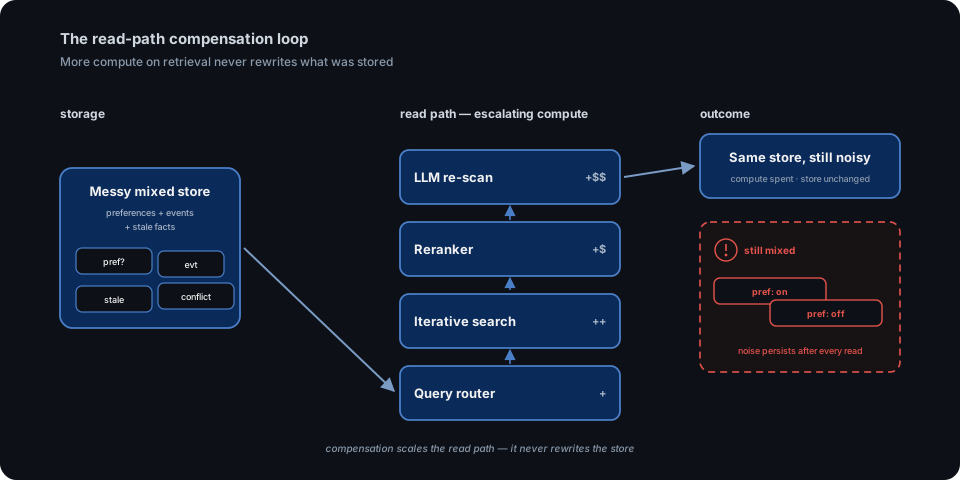
What follows is the case for the write path, priced honestly. Each of the three preprints gets its mechanism quoted verbatim, its numbers attributed per authors with the hedges their papers wear, and — where this series always puts cost — its bill stated before its win, so a reader can decide what to adopt without needing a leaderboard to decide for them. The middle of this post is deliberately unflattering: an LLM-dependent write pipeline, periodic view convergence, call counts an order of magnitude above the baseline, and an ablation that undercuts its own headline. What lands at the end is a decision table — approach, best at, fails at, build when — plus a short watch list for where the field's center of gravity may be sliding, from retrievers toward organizations of the store itself.
What the read path is really paying for
Rerankers, query routers, iterative search, and LLM re-scans are four line items in one budget — compensation. Each stage exists because the store cannot answer on its own. The router guesses which shard might hold the fact, because nothing tagged the fact with its scope when it was written. Iterative search widens the pool past the first top-K, because that first cut mixed current claims with superseded ones that were never retired. The reranker re-orders neighbors, because extraction stored three phrasings of one event as three independent truths with equal standing. The LLM re-scan reads the candidates again, because no index knows which of them is still valid. Four machines, one job: re-derive distinctions that should have been recorded once at ingest. That is the compensation loop the figure above draws, and the defining property of a loop is that it closes on every query — the tax is not paid when the store is written, it is paid forever after, whether or not the answer needed the structure it just rebuilt.
Saying the read path is not wrong matters — because it is not wrong. Ranking work is not a mistake, and no team should delete its reranker the day it adopts a write-time discipline. Cross-encoders lift answers from any store, structured or flat, and for an organization stuck with months of existing ingest the read path is the only layer available this quarter. The problem is the marginal curve, not the technique: each additional stage buys less, because the cheap distinctions — validity windows, provenance, supersession, scope — are exactly the ones inference reconstructs expensively at query time. A reranker deciding which of two conflicting facts outranks the other is performing write-time arbitration with a scoring model and no memory of what happened. On long-horizon agents the arithmetic gets worse: the same reconstruction runs at turn four and at turn four hundred, scaled by every tool call in between, while the underlying store stays exactly as noisy as the day it was written. Sophistication on the read path is a loan against structure never recorded, and the interest compounds per token.
The reframe to carry into the next three sections: ask what the write path failed to record. Not “which retriever is better,” but “which distinction is the read path inferring today that ingest could have written down for the price of one field?” Each of the three papers answers with a different field — semantic views, relation roles, typed graph edges — and the tell is that none of them ships a new ranking architecture as its headline. They make retrieval boring again, which is what structure at write time buys: the read path stops being the place where memory is repaired and goes back to being the place where memory is asked a question. For long-horizon work that inversion is the whole game, because the store is asked the question thousands of times and written once.
AutoViewMem — disentangle before you index
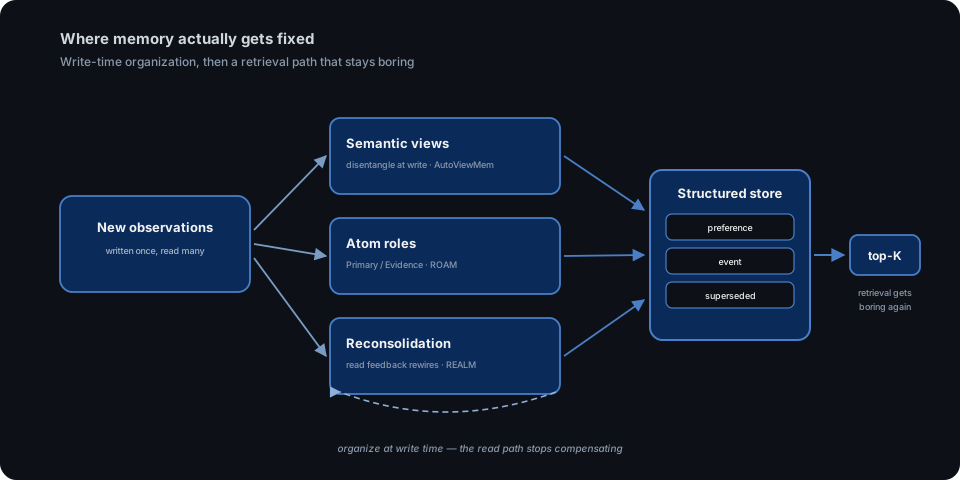
Disentangle before you index — the paper states the move in one sentence worth quoting whole. AutoViewMem (arXiv:2609.21940), Cao et al., v1 September 18 2026, preprint, starts from a fact every agent-memory engineer has felt: interaction traces mix concerns — who acted, what was observed, when a claim held, what it depended on — and a single flat record forces retrieval to untangle that mixture on every query. The mechanism, verbatim: “AutoViewMem discovers candidate views from interaction traces, selects a compact complementary view set, and uses these views to guide write-time structured extraction of provenance-grounded memories.” Candidate views are discovered from the traces themselves rather than declared by hand, the chosen set is compact and complementary instead of exhaustive, and the extraction that follows is provenance-grounded — each memory carries where it came from, decided before anything is indexed.
The representation moves so the search can stay boring — and boring search is the point. Second verbatim sentence: “This representation-first design moves semantic disentanglement from retrieval time to write time, allowing standard top-K similarity search to retrieve focused evidence without explicit routing or iterative retrieval.” Read that against the previous section: no router guessing shard scope, no iterative widening, no second pass to re-mix what extraction already separated. The views are self-configuring — low-overlap semantic views assembled before indexing so a query hits one lane instead of three — and consolidation runs offline over buffered traces, so the view set keeps converging as experience accumulates rather than being hand-tuned after the first bad answer. What the authors are claiming, per authors and not yet peer-reviewed, is that the interesting work happened before the query existed.
Scores, per authors, with their scope attached. Evaluation covers LoCoMo and PersonaMem with Qwen3-8B and Qwen3-14B backbones. On PersonaMem-32k it outperforms the strongest baseline by over five points — Table 2: 69.10 vs A-mem 63.33, +5.77 — and Full History by nearly fourteen points (+13.92) under Qwen3-14B, per authors. On LoCoMo, overall Judge reaches 0.837 with Qwen3-8B and 0.853 with Qwen3-14B, per authors. These are the paper's own prose figures on two named benchmarks — no abstract win rate hangs over them, and the next section prices what the pipeline costs before anyone ports it.
The bill for learning at write time
The paper's own Conclusion itemizes the bill — and this series quotes bills before wins. AutoViewMem depends on the underlying LLM for view discovery, extraction, and consolidation, so write quality tracks whatever model is wired in, and every ingestion pays inference for structure that a fixed schema would have given free. View convergence runs periodically from buffered traces — not fully online — which means a fresh domain spends a warm-up window writing before its views settle, and answers drawn before convergence inherit the flat store's ambiguities. Offline consolidation can over-merge when subtle temporal changes should have kept two items separate; the authors note that provenance retention reduces this risk, which is the tell that provenance here is load-bearing rather than decorative. Evaluation is limited to LoCoMo and PersonaMem, and the authors state plainly that broader validation is needed — all per authors, from their own Conclusion, on a preprint that is not yet peer-reviewed.
Stating the bill first is not a takedown — it is why the bill is worth reading. Swapping the underlying model later does not only change answer style here; it changes the shape of the store the views produced, which means view discovery and extraction are coupled to a model choice the team may want to revisit. A write pipeline that costs LLM calls, a convergence cadence, and an over-merge risk is still cheaper than a read path that re-derives structure at query time forever, provided the workload outlives the write. The honest question for a team evaluating any of these three is where its own bottleneck sits: an agent that answers a few thousand queries against a store written once amortizes write cost easily, while an agent whose store churns continuously re-pays convergence on every flush. That accounting sets up the next paper. If write-time organization carries this bill, the obvious question is what else the write path can be asked to decide — and ROAM's answer is collisions: what to do when the incoming fact does not agree with what the store already holds.
ROAM — classify the collision before storing
Classify the collision before storing — arbitration at ingest instead of ranking at query. ROAM (arXiv:2609.09778), Zheng et al., v1 September 9 2026, preprint, 21 pages, treats every new observation as a potential collision with what the store already holds. The mechanism, verbatim: “ROAM classifies incoming–stored atom pairs as independent, equivalent, directionally subsuming, or conflicting, then organizes observations into active Primary and supporting Evidence roles.” And the retrieval consequence, also verbatim: “Only Primary views are retrieved for answering, preventing redundant or outdated atoms from competing independently.” The ranked list shrinks at the source — the store already decided which atom speaks and which is demoted to supporting evidence, so top-K no longer has to choose between a fact and the version that replaced it. Both sentences describe write-time work: the classification runs when the observation arrives, and retrieval later simply reads the roles the arbitration assigned. That is the same relocation §1 named, executed as a four-way decision per atom pair instead of a view layout per trace.
Accuracy moves most where interference is worst — per authors, cell by cell. ROAM improves answer accuracy by up to 29.8 percentage points — per authors, the exact cell is LongMemEval Controlled, interference N=8, 256-token memory budget, Qwen3.5-9B manager: 71.9 vs strongest baseline Mem0 42.1. Answer-critical source recall runs 15.6 points higher — 84.6% vs 69.0% gold-source recall against Mem0 — and confounder-token share sits 11.5 points lower, 47.1% vs 58.6%, per authors. The pattern holds across manager scales: on the Gemma-4 family, E4B → 12B → 26B-A4B scores 69.4 → 71.3 → 74.5, a ~5.1-point gain, per authors. Interference, recall, confounders, scale — four axes pointing the same way, which matters because the failure being fixed is interference: wrong facts winning slots they should have lost at write time.
The appendix bills the arbitration in two currencies — and the split is the insight. Per authors Appendix, explicit relation management runs ~271.6 LLM calls per episode (N=4) versus Mem0's ~30.1, but generated output volume is ~1.90k tokens — ~83.4% fewer than Mem0's 11.46k. Fine-grained relation inference trades call count for output size: many small decisions at write time instead of one large dump, and the accounting balances only for workloads that read more than they write. Their own caveat keeps the claim inside its fence: gains should be interpreted within the evaluated settings — benchmark histories, controlled budgets — and the method targets short extracted factual units only, with hierarchical and event-level memories left unexplored, per authors. That is not a weakness to argue around; it is the scope statement to read before designing a schema on top of it.
REALM — let reads rewrite the store
Let reads rewrite the store — the third paper moves the feedback loop rather than the schema. The full title is “Retrieval-Driven Memory Reconsolidation for Long-Term LLM Agents”; REALM is the framework acronym only — reconsolidation-evolution agentic long-term memory — and the paper is arXiv:2609.16053, Song et al., v1 September 13 2026, preprint. The mechanism, verbatim: “It models long-term memory as a continual lifecycle by autonomously organizing memories into a heterogeneous cognitive graph, retrieving evidence via adaptively composed graph-search atoms, and continually reconsolidating memories based on retrieval feedback.” Where AutoViewMem organizes once at ingest and ROAM arbitrates each arrival, REALM treats every retrieval as evidence about how the store itself should be reshaped — reads become writes. The feedback is the differentiator: nothing in the first two papers looks at which answers succeeded and revises the organization afterward, and nothing here needs a hand-tuned schema up front, because the graph is continually edited by the traffic it serves.
Headline numbers with the setup attached — per authors. Average accuracy 75.97% on LoCoMo, outperforming the strongest baseline (MAGMA, 68.80) by 7.17 points; 65.11% on LongMemEval, surpassing the previous best (Zep, 63.80) by 1.31 points — and the LongMemEval setup tested only LongMemEval_S, which belongs in the sentence rather than a footnote. The graph underneath carries typed nodes — entity, event, episode, fact — and typed edges — logical, causal, hierarchical, associative — so reconsolidation has relations to move rather than chunks to reshuffle. Both figures are per authors on preprint v1, not yet peer-reviewed, and both should be read next to the ablation the same paper reports.
The ablation undercuts the headline, and the authors say so themselves. Reconsolidation alone is worth ~+2.01 on LoCoMo (73.96 → 75.97) and ~+2.13 on LongMemEval (62.98 → 65.11), per authors — most of the headline delta comes from the graph framework itself, not from the read-to-write loop. Their caveat, quoted as printed: “the relatively small margin also reveals a limitation of the current design: the benefit of adaptive retrieval ultimately depends on reliable strategy selection, and inaccurate decisions may reduce the advantage over carefully designed fixed strategies.” The honest read: the lifecycle framing is the contribution worth stealing, the loop's marginal gain is real but small across these two benchmarks, and a fixed strategy chosen well can still beat an adaptive one that chooses badly.
The synthesis — three routes, one write path
Three groups, three mechanisms, one direction — the write path is where memory quality is decided. AutoViewMem organizes semantic structure at write, ROAM arbitrates collisions at write, REALM lets reads reorganize what was written and writes the result back. None of the three leads with a new retriever; each makes the existing top-K do more with less machinery, which is the signature of structure paid once instead of per query. The differences still matter for choosing — views suit traces that mix concerns, Primary and Evidence roles suit stores drowning in duplicates, a reconsolidation loop suits agents whose queries keep revealing that the graph was shaped wrong — but the shared claim is the point of this post: read-path sophistication is a symptom, and all three papers treat it as one.
One sentence on where this lands in practice. A temporal knowledge graph with supersede-not-overwrite and provenance is the same discipline at the persistence layer — in OpenZync, consolidation and supersession happen at ingest, so reads inherit structure instead of paying to rediscover it.
Where each approach earns its keep
The honest guide to the layer, read as jobs rather than products — and read with every paper's per authors, not yet peer-reviewed hedge intact:
| Approach | Best at | Fails at | Build when |
|---|---|---|---|
| AutoViewMem | Write-time semantic views — low-overlap disentanglement before indexing, after which standard top-K suffices per authors | LLM-dependent write pipeline; periodic view convergence from buffered traces, not fully online; over-merge risk in offline consolidation | Long traces where one flat record would force disentanglement again at every query |
| ROAM | Collision arbitration — Primary and Evidence roles, per authors up to 29.8 percentage points under interference | Call-count overhead, ~271.6 vs ~30.1 calls per episode per authors; short factual units only — hierarchical and event-level memories unexplored | Stores where conflicting, duplicate, or superseded facts compete for the same top-K slots |
| REALM | Lifecycle reconsolidation on a typed cognitive graph — read feedback reorganizes the store | Strategy-selection sensitivity, per authors; small margins — reconsolidation alone worth ~+2.01 and ~+2.13 | Agents whose queries routinely reveal that the graph was shaped wrong |
| Retrieval-side fixes — rerankers, routers, iterative search | Immediate gains without touching ingest — compensates any store, structured or flat | Recomputes structure on every query; the stack grows while the store stays as noisy as written | Legacy stores that cannot be rewritten this quarter, or residual ranking gaps on an already-structured store |
| OpenZync | Temporal knowledge graph — supersede-not-overwrite with provenance, consolidation and supersession at ingest | Routing and retention policy still operated by the team — no benchmark scores claimed | Provenance and audit matter — facts must know what they replaced and when they held |
Read the rows against the compensation loop, not the feature list. The first row moves disentanglement to ingest so the loop shortens to plain top-K — at the price of an LLM in the write pipeline and a convergence cadence. The second row demotes redundant atoms before they can compete, which is why its interference cell jumps while its call count does the opposite; the call-count-versus-output-size split is the pricing signal to carry into any procurement conversation. The third row keeps the loop alive after ingest and honestly reports that most of its headline comes from the graph rather than the loop. The fourth row is what every team already runs — legitimate, compensatory, and capped by how much structure the store never received, which is exactly the ceiling the figure in §1 drew as a red dashed band. The last row is a persistence shape for the discipline all three papers argue for, offered without a score the preprints did not give it. Work down the table from the column that hurts: if the failure is duplicates competing for slots, row two; if it is mixed concerns in long traces, row one; if the graph keeps drifting out of shape under real queries, row three; if ingest cannot move this quarter, row four is the honest holding position rather than a verdict against the others.
What to watch
Four signals will mark where this lands — none of them a product announcement, all of them evidence, each stated with the hedge its source requires.
The write path becomes the benchmarked layer. Watch for leaderboards that score organizations — view quality, collision-handling accuracy, supersession correctness — rather than only retrievers, because the three September preprints all locate the lever at ingest and benchmarks tend to follow where the levers are. If the pattern holds, the interesting entries will read like storage-quality reports: how much structure a write pipeline produced per unit of ingest, and how little machinery the read path needed afterward. Per authors, none of the three papers claims that generalization yet — two benchmarks each, preprint v1 — so the signal to watch is whether independent evaluations pick up the same axis.
Consolidation and call-count costs become the price metric. Accuracy without an ingest bill is half a comparison, and ROAM's appendix — ~271.6 calls against ~30.1, against ~83.4% fewer output tokens — is the shape of accounting the field may standardize on: calls per episode, tokens generated, convergence windows, inference required per write. Watch for cost sections moving from footnotes to abstracts, and for reviewers asking which of the three currencies a proposed method spends. The teams already paying per-token ingest will care first, because for them the write path is not an architecture diagram — it is an invoice.
Reconsolidation-style read-to-write loops spread. REALM's lifecycle — retrieve, evaluate, reorganize, store — is the most portable of the three ideas and, per authors, also the most strategy-sensitive: inaccurate selection can erase the advantage over a carefully fixed strategy. Watch for the loop appearing in systems that never cite the paper, in plain terms like feedback-driven indexing or query-aware compaction, and watch for the reliability question to surface immediately wherever it appears. Whether the spread happens is not a certainty — a loop that writes on every read can also amplify its own mistakes — but the direction worth monitoring is retrieval results becoming signals about store shape instead of only answers.
Read-path vendors absorb write-time ideas, or do not. The established stack — routers, rerankers, iterative retrievers — has two available moves: absorb consolidation, deduplication, and supersession into the indexing pipeline, or defend the compensation loop as permanently necessary. Watch product changelogs for write-time dedup and validity windows arriving under old retrieval branding, and watch for the opposite outcome too, where the read path absorbs everything and the write path stays flat. Per authors across the three papers the argument for the second outcome got weaker this September; whether the market follows the argument is the open question, and it will be answered in features rather than footnotes.
The memory your window throws away
The memory a window throws away is the structure a write path never kept. Every reranker in the world cannot tell two conflicting facts which one superseded the other, because ranking is a reading skill and supersession is a writing decision — the same lesson this series has now traced through twenty posts, from fifty-turn collapses to poisoning to cost, arriving at last month's preprints pointing at ingest. The uncomfortable correction of this post is not that retrieval is bad. It is that a smarter read path, on a store written without structure, is the most expensive way to re-derive what a field at write time would have recorded once. Three independent September 2026 preprints — per authors, not yet peer-reviewed, every number above hedged where its paper hedges it — converge on the same relocation: organize at write, arbitrate at write, let reads feed back into what was written. On a long-horizon agent the difference compounds precisely because the store is read far more often than it is written, and only one of those two events can carry the cost of creating structure. The practical version of the correction is small enough to start anywhere: before buying another retrieval stage, list what the read path currently infers — which facts are current, which pair describes one event, which claim's source can be trusted — and price writing each of those down once instead of recomputing it on every turn.
OpenZync is a self-hostable temporal knowledge graph for agent memory — supersede-not-overwrite at ingest with provenance, so every read starts from a store that was organized when it was written. Start with the memory & context docs and the openzync-mcp repository.
This is part of a series on agent memory. Read why context windows aren't memory, then how a temporal knowledge graph is built, then the honest map of agent memory tools, then the five patterns of graph memory, then the MCP memory-server field guide, then when agents talk to each other, who remembers, then the new attacks on AI memory, then team memory and who fixes a wrong fact, then the gap between benchmark scores and agentic memory, then what happens when agents remember things that never happened, then your agent doesn't need a knowledge graph, it needs a search box, then context engineering won't fix your agent's memory, then everyone ships an llms.txt, almost no agent reads it, then your agent's memory file is how mind viruses spread, then MCP and A2A have a foundation now, then the right to be forgotten meets agent memory, then cheap memory is the expensive option, then your RAG pipeline is not how ChatGPT remembers you, then your agent loses its mind after fifty turns, then the post that started it all.