
Memory never arrives as an invoice line
Every other cost in an AI stack announces itself. Model spend arrives on a provider invoice with per-model breakdowns. Retrieval arrives on a vector-database plan with a quota dashboard. Even evaluation gets its own line, because someone eventually asks what the evals cost. Memory bills none of these ways. It arrives disguised — as extra tokens inside construction calls nobody itemizes, as retrieved payload injected into queries that look like ordinary prompts, and as work quietly done twice because the agent forgot it had already done it once. A cost that never appears as a line item is a cost nobody owns, and agent memory has become the least-governed line item in AI budgets for exactly that reason: it never appears as one at all.
The scale of the disguise is easy to underestimate. A simple chatbot makes one LLM call per turn. An agent task, by AgentMarketCap’s illustrative estimate of April 8, 2026, triggers “10 to 20 sequential model invocations” — and every one of those invocations carries context on memory’s behalf: stable system content, retrieved facts, summaries of what happened last time. A modest per-call overhead multiplied by twenty calls, by every session, by every day, is real money spending itself on a layer that appears in no budget anyone reviews.
The disguise survives every dashboard review because of where the tokens land. Finance sees one aggregate — token spend by model — and memory’s share dissolves inside it: construction calls look like ordinary completions, retrieval payload looks like prompt length, redundant work looks like chatty users. No provider breaks out “memory” as a category, because no provider knows which tokens were serving memory; that classification happens nowhere in the stack. The bill is not merely unrendered — it is structurally unrenderable until someone decides, application by application, which tokens were memory’s fault.
The people who watch production systems have noticed. Waxell, an agent-governance vendor, put it plainly on May 4, 2026: “And in 2026, with context windows exceeding 200,000 tokens and frontier model input pricing in the range of $2.50–$5 per million tokens, it has become one of the most significant and least-governed cost drivers in production AI systems.” Note who said it — the loudest voice naming the governance gap is a company that sells governance tooling. Hold that detail; it returns at the end of this post as a market signal in its own right.
This post prices the layer honestly: what memory actually costs, what the benchmarks found when they finally started measuring, why the cheapest-looking option — resending everything — can be the one that never breaks even, and when the supposedly expensive option turns out to be the cheap one. The synthesis compresses to one line: price memory like infrastructure — cost per correct answer, not vibes.
The three bills memory actually sends
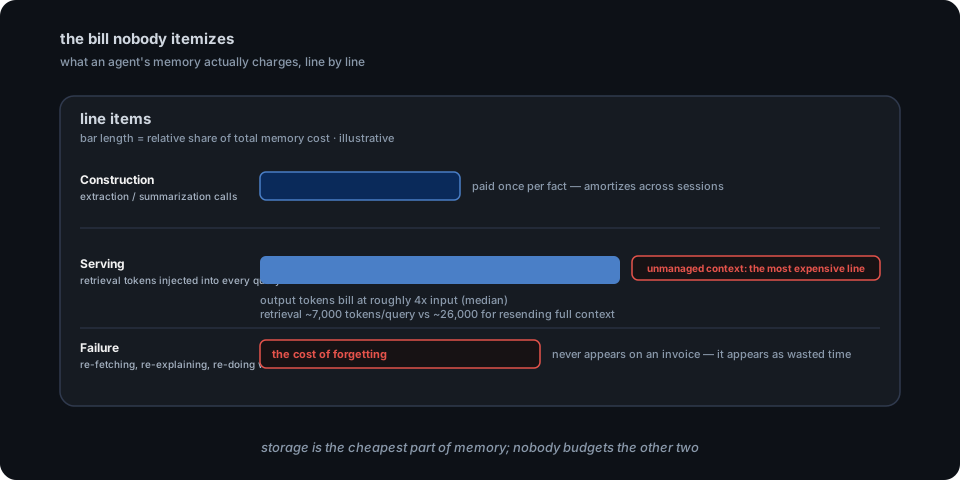
Memory’s cost model confuses budgets because it is not one bill but three, arriving on different schedules, owned by different teams, and visible on different instruments — two of which do not exist yet.
Construction is the bill teams expect. Every extracted fact, every summary, every embedding was produced by LLM calls somebody paid for: reading the conversation, deciding what matters, writing the durable version. It resembles every other data-pipeline bill, which is why it is the only one that gets budgeted. Its saving grace is amortization — a fact extracted once serves every future session that retrieves it — so construction cost per use falls toward zero the longer the memory lives and the more the agent returns to it.
Serving is the bill that recurs forever. Every query pays again: retrieved facts ride into the prompt as tokens, every turn, every session, scaling with traffic rather than with corpus size. To make it concrete, mid-tier frontier pricing currently runs around $2–3 per million input tokens and $10–15 per million output tokens (AgentMarketCap, April 8, 2026), so a few thousand retrieval tokens per query is a rounding error — until it is multiplied by millions of queries, at which point it is a department. The serving bill is the one that scales silently, because each individual query looks free and the aggregate never renders anywhere.
Failure is the bill nobody can see. Forgetting has a price, and it is paid in re-fetching what was already fetched, re-explaining what was already explained, and re-doing work that was already done. It hides inside other line items — longer conversations, more clarification turns, escalations a confident agent would have closed — so it shows up nowhere as memory cost, even though memory’s absence caused it. The failure bill is denominated in output tokens and human patience, which happen to be the two most expensive currencies in the stack.
Worse, the three bills land in different quarters and different budgets, so nobody ever sees them stacked. Construction spends at build time and gets absorbed into engineering effort. Serving spends continuously and hides inside inference spend. Failure spends unpredictably and hides inside support costs and user patience. Stacked in one place, the picture is legible; scattered across three ledgers, each slice looks survivable and the sum never renders anywhere.
Any honest accounting prices all three. Until recently, nothing did — which is why the benchmarks that started measuring cost are the most useful thing to happen to this layer all year.
The benchmarks finally started pricing memory
For most of its short life, agent memory was evaluated on accuracy alone: did the agent recall the fact, yes or no. 2026 is the year cost joined the scorecard, from two directions at once.
The sharper instrument is “Total Recall at What Cost?” (Pollertlam and Kornsuwannawit, arXiv:2608.11879), an arXiv preprint submitted August 12, 2026. It benchmarked three commercial memory systems — deliberately left unnamed here, because the finding generalizes past any vendor — against two reference strategies, a fixed-size rolling window and resubmitting the full transcript, across two backbones and conversations of up to 400 turns, pairing every cost measurement with answer accuracy on 665 LoCoMo questions. Three findings, each uncomfortable in its own way.
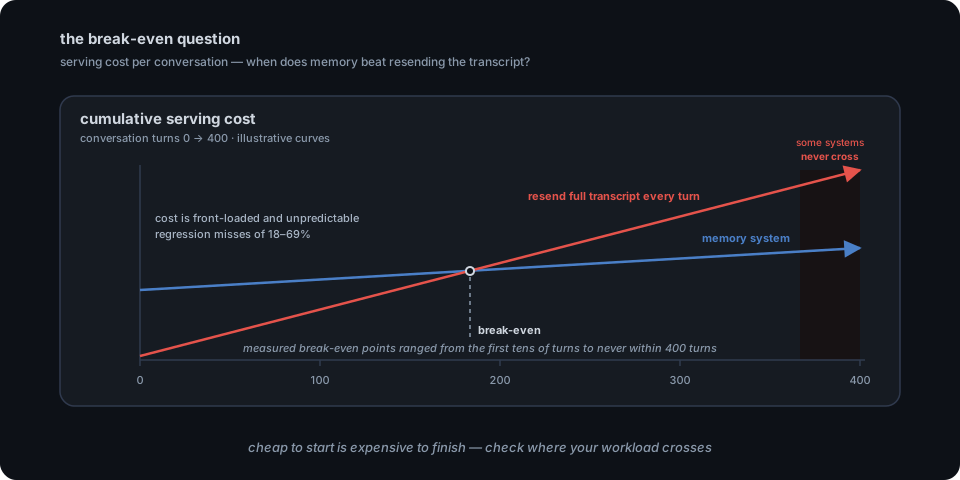
Serving cost cannot be predicted from input size. A regression that tracks conversation length and message size closely follows the two reference strategies — and misses the memory systems by 18–69%, because their cost is driven by internal memory behavior: what gets consolidated, when, and how often. You cannot budget a memory system by counting the tokens you feed it. Two systems that look identical on a features page can differ by half again their serving bill, and the difference is invisible until the invoice arrives.
Break-even is empirical, not architectural. Whether a memory system ever becomes cheaper to serve than the full transcript runs “from the first tens of turns for the cheapest to never within 400 turns for the most expensive.” Four hundred turns — a month of a busy support thread — and the most expensive configuration never repays its own overhead against a strategy that costs nothing to construct. Payback is a property of the specific system on the specific backbone, not a guarantee that comes with the category.
Nobody wins both axes. Accuracy spans 21–54% across the systems tested, and the backbone choice moves cost as much as the memory system does. There is no configuration that is simultaneously the cheapest and the most accurate; every choice is a trade, and the trade is only visible when cost is measured alongside accuracy — which is the whole point of the benchmark existing.
The vendor side reached the same conclusion by a different route. Mem0’s State of AI Agent Memory 2026 report — vendor research, published April 2026, with its evaluation framework open-sourced at github.com/mem0ai/memory-benchmarks — promotes token consumption and latency to first-class benchmark dimensions alongside accuracy: BLEU, F1, LLM-judge scores, token consumption, and latency reported together. Its published results pair every score with a token bill: LoCoMo 92.5 at roughly 6,956 tokens per query on average, LongMemEval 94.4 at roughly 6,787. And the comparison that frames the whole market: a full-context baseline runs about 26,000 tokens per conversation where a retrieval call runs roughly 7,000 — a vendor-reported figure, but directionally the difference between a memory layer that scales with sessions and one that drowns.
Two independent efforts, one convergence: the interesting number is no longer the score. It is the score divided by what it cost to serve.
The hidden bill is forgetting
The failure bill deserves its own accounting, because the industry has started monetizing its relief — and nothing confirms a bill exists faster than people paying to make it stop.
Start with the structural problem. A stateless agent re-pays for its context every session: no durable memory means every conversation starts from zero, re-ingests the documents, re-derives the preferences, re-learns the codebase. The construction bill a memory system pays once, the stateless agent pays eternally, at full price, per session — it simply books the cost as “how agents work” instead of as memory spend.
Concretely, the failure bill reads like this: a support agent that forgot last week’s troubleshooting session walks the customer through the same five steps again — five steps of output tokens, five steps of the customer’s patience. A coding agent that forgot a stated constraint re-proposes the rejected design, and the reviewer re-reviews it. A research agent that forgot which sources it already discarded re-summarizes them. Not one of those events appears anywhere as “memory cost.” They appear as slow tickets, long diffs, and duplicated reports.
The providers have started selling the cure. Anthropic’s context-management work reports that context editing — clearing stale tool results and irrelevant turns from the window — cut token consumption by 84% on a 100-turn web-search evaluation, and that pairing the memory tool with context editing raised task success by 39% on a complex multi-step benchmark. Read the second number carefully: it is not a cost saving. It is a quality gain from remembering the right things across steps — the failure bill showing up in a benchmark where anyone can see it.
Production teams are doing the same arithmetic themselves. Zylos Research’s May 27, 2026 write-up of production practice found teams clearing tool results to reclaim 30–60% of session context — manual, ad-hoc versions of what Anthropic productized. When platform vendors ship features whose entire value proposition is relieving context bloat, and teams adopt them, the bloat was never free. It was a bill addressed to whoever happened to be holding the context that day.
Which is the quiet punchline of this section: money is visibly changing hands across the industry to make agents remember less expensively and recall more reliably. The forgetting bill is real. It is simply never rendered as a bill — it is rendered as slower answers, redundant work, and context windows stuffed with yesterday’s tool output.
Why the cheap-looking choices get expensive
Given three bills and no invoice, the rational-sounding shortcut is to build nothing: keep no memory, resend the whole transcript every turn. Zero construction cost, zero retrieval infrastructure, nothing new to govern. The benchmarks explain precisely where that logic dies.
Resubmitting the transcript is the reference strategy the Total Recall preprint measured everything against — and the headline finding was that the most expensive memory system never broke even against it within 400 turns. But read the curves in the other direction: the transcript strategy’s cost climbs with every turn, forever, while memory-system curves flatten once construction amortizes. Short chats favor resending; the entire question is where a given workload sits on the curve — and the first finding says you cannot predict that from conversation length alone. Cheap-looking is not cheap. It is unpriced.
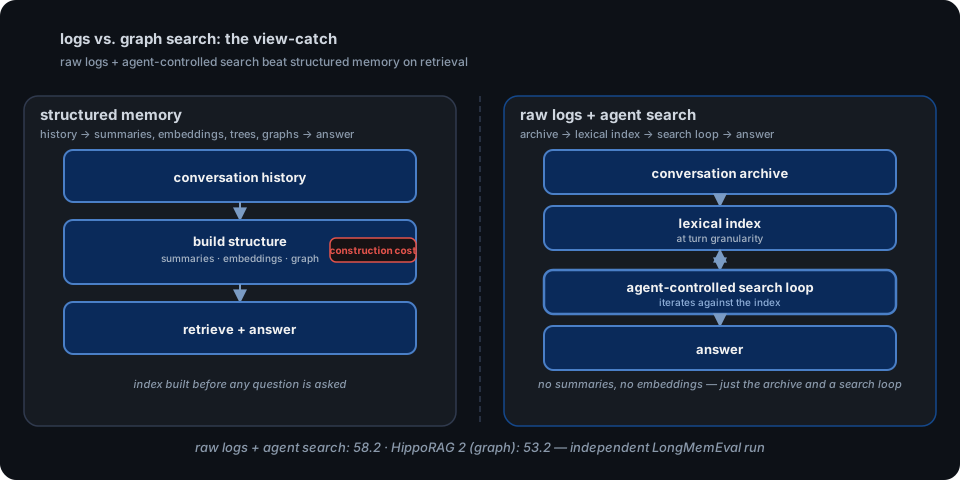
That construction-cost tag, first drawn in your agent doesn’t need a knowledge graph, it needs a search box, is the right lens here too: the visible build step is what makes people call structure expensive, and the unlabeled per-turn climb on the other side is what makes resending look free. Both labels are lying by omission.
Verbose retrieval pays the output multiplier. “Output tokens are billed at 3–8x the rate of input tokens across frontier providers,” and the “median output-to-input price ratio in 2026 is approximately 4x” (AgentMarketCap, April 8, 2026). Retrieval that answers verbosely — long syntheses, restated context, generous framing — pays that multiplier on every wasted word. At a 4x median, sloppy verbosity in the serving path costs four times what the same sloppiness would cost on the input side.
Compact formats carry their own tax. This series covered the grep-tax finding in [why context engineering won’t fix your agent’s memory]: compact and novel formats incur token overhead through “grep output density and pattern unfamiliarity” (arXiv:2602.05447 abstract). Compression is not automatically savings — a format the model has to work to parse can spend more than it saved, which is how an optimization becomes a surcharge.
Fan-out multiplies everything. Naive multi-agent propagation costs 4–15x more tokens than a single agent handling the same task (Zylos Research, May 27, 2026), because every agent in the chain resends its slice of shared context. Memory decisions compound under fan-out: a wasteful per-query habit that costs pennies in one agent costs a multiple of it in a swarm.
There is a meta-cost too: every one of these traps is invisible in a demo and visible in month three. Prototypes resend transcripts because resending is free at ten turns; the architecture decision gets made where it is cheapest to evaluate, and pays where it is most expensive to run.
None of this says memory is expensive. It says the pricing intuitions are inverted: the option with no visible bill is the one whose bill grows every turn, and the option with an upfront bill is the one whose per-turn cost falls. The next section argues the inversion properly.
When expensive memory is cheap
The honest case for structured memory is an amortization argument, and it deserves to be made with numbers instead of adjectives.
Construction is a fixed-ish cost that amortizes across every future session; serving is a recurring cost that structured recall drives down. On mem0’s vendor-reported comparison, full context runs about 26,000 tokens per conversation against roughly 7,000 per retrieval call — per-query tokens down by roughly a factor of four. Compound that across a long-lived agent — hundreds of sessions, thousands of queries — and the construction bill stops being the story; the per-query delta is the story, and it recurs in memory’s favor every single time.
The measured case exists at small scale too. Mem0’s playbook post of May 6, 2026 shipped an open comparator script and one concrete result: 594 prompt tokens collapsed to 166 — a 72% reduction on a single 24-entry store — with both the memory-based and baseline answers judged correct. One store, one query shape, vendor-run; but the script is public, which makes the claim reproducible rather than testimonial.
Their broader marketing claim needs its hedge worn openly: mem0 asserts that naive full-context or naive RAG setups “typically run 3 to 5 times higher token costs than necessary.” That is a vendor estimating its own market, not a neutral measurement — treat the range as directional evidence that waste is common, not as a benchmark result.
The tradeoffs stay real, and honesty requires them in the same breath. At extreme scale the same vendor report shows BEAM scores of 64.1 at one million tokens falling to 48.6 at ten million — long-horizon recall is unsolved, and paying for memory does not purchase competence at horizons nobody has solved. The Total Recall constraints bind here too: accuracy spanned 21–54% with no system winning both axes, so some configurations visibly buy latency or cost with correctness. And extraction quality improves with investment — mem0 reports gains over its prior algorithm of +29.6 points on temporal queries and +23.1 on multi-hop — but improvements are purchased with construction calls, which loops straight back to bill one.
And the honest middle runs both ways: there are workloads where structured memory remains the expensive option. A chatbot answering from a static document set, sessions that never recur, conversations that end inside ten turns — for these, construction never amortizes and the retrieval call never earns its discount. The claim this section makes is conditional, and the condition is the workload: repetition, longevity, and compounding correctness are what convert an upfront memory bill into a per-query saving. Absent those, row one of the next section’s table stays the correct answer.
The summary survives compression: expensive memory is cheap when conversations run long, sessions repeat, and correctness compounds — and genuinely expensive when they do not. The workload decides. Which is exactly why the workload needs a price, not a vibe.
Price memory like infrastructure
Nobody budgets a database by intuition. Infrastructure gets unit metrics — cost per transaction, cost per query — and capacity plans, and someone accountable when the number moves. Memory needs the same treatment, and 2026 finally supplies the instruments.
Cost per correct answer is the headline metric. The checklist metric proposed in the gap between benchmark scores and agentic memory — tokens per correct answer — matures here from a suggestion into the number benchmarks now effectively report: accuracy and serving cost measured on the same questions in the same run. A score without a serving cost is a score nobody can budget against; a score divided by its token bill is a number a finance team can actually own.
Cost per session catches what per-query misses. Amortization only appears at session granularity: construction spread across the sessions that reused it, failure costs visible as extra turns. A stale answer has a price too — the correction conversation, the re-run, the trust spent — and it lands on the session ledger, not the query one.
Model choice is part of the memory architecture. Per provider pricing pages checked August 25, 2026, OpenAI’s GPT-5.6 family runs from Luna at $0.20 per million input tokens to Sol at $4.00 — a 20x input-price spread inside a single model family — with Terra at $2.00 between them; Anthropic’s Sonnet 5 ($2 input) and Opus 5 ($5 input) bracket similarly. Routing research points the same direction: RouteLLM (ICLR 2025) reported an 85% cost reduction at 95% of GPT-4 performance by choosing models per query. The same memory architecture re-priced across models moves the bill before memory does anything at all — so the pricing exercise has to run jointly, architecture and model together.
Unit metrics also do something subtler: they give memory an owner. “Token spend” has no owner because it belongs to everyone; “cost per correct answer on the support agent” belongs to the team that owns the support agent. Infrastructure costing works precisely because it attaches numbers to things teams control — and once a team can watch its own number move after an architecture change, memory stops being weather and becomes engineering.
This is also, stated at the same level tone as everything above, the argument for owning the layer. OpenZync is self-hostable — a temporal knowledge graph you run alongside everything else you run — which means the unit economics in this section are yours to measure and govern, not a vendor’s to summarize for you. No cost numbers are claimed here for any product, ours included; the point is who holds the meter, not a number printed on it.
The decision table
The honest guide to the layer, read as jobs rather than products:
| Layer | Best at | Fails at | Cost profile |
|---|---|---|---|
| No memory (resend transcript) | Zero build cost, zero moving parts | Per-turn token growth steepest of any option | Prototypes only |
| Prompt caching | Amortizes stable prefixes across calls | Doesn’t dedupe new retrieval content | Stable-system-content workloads |
| Vector RAG | Semantic recall on demand | Retrieval tokens every query; stale-chunk risk | Large document corpora |
| Structured memory | Lowest per-query tokens after construction pays in | Build and extraction cost arrive first | Long-lived multi-session agents |
| OpenZync | Temporal knowledge graph; supersede-not-overwrite | No benchmark scores claimed | Self-hosted — you own the unit economics |
Read the rows as jobs. Row one is what every prototype ships with, and the curves above are its honest cost profile: free until it isn’t, then steepest thing on the page. Row two is a pricing optimization, not a memory system — it discounts what is stable and does nothing for what is new. Row three rents semantic reach per query, which is the right deal for big corpora and the wrong deal for hot, repeated questions — and hot repeated questions are exactly where serving bills concentrate, which is why the same vector store can be cheap for one team and ruinous for its neighbor. Row four pays first and saves later, which is the entire amortization argument of the previous section. Row five is this series’ bet — the semantics of row four with supersession and provenance attached — offered with the standing caveat of every table in this series: no benchmark scores claimed, because the benchmarks above priced the category, not this implementation.
What to watch
Four signals will mark where this lands. None of them are product announcements; all of them are evidence.
Tokens per query becomes the headline benchmark number. The migration is already visible — token consumption and latency sitting beside accuracy in mem0’s framework, cost-and-accuracy paired in the Total Recall design. The maturity signal is when the paired number stops being remarkable enough to blog about, and “tokens per correct answer” prints in the leaderboard’s main column. The gap between benchmark scores and agentic memory called this shot; watch it land.
Cost-governance tooling becomes a category. Remember who supplied this post’s epigraph: a governance vendor is the loudest voice calling memory the least-governed cost driver. Vendors naming a gap they sell tools for is either opportunism or a leading indicator — usually both. Either way it is a signal: when the governance cohort pivots budget slides toward memory spend, the buyer’s side of the market has started asking the same question this post does.
Provider price moves reshape the math overnight. A 20x input-price spread inside one model family means a routing decision can move a memory bill more than any architectural change — and provider repricing can move it back. Teams pricing memory against one model’s rates are solving an equation whose constants change without notice. The watch-item is not any single price cut; it is whether memory architecture choices get re-evaluated when prices move, or silently rot.
Cache-aware memory architectures converge. Zylos Research’s May 27, 2026 synthesis found production converging on three strategies: “tiered memory architectures that keep hot state cheap and cold state out-of-band, prompt caching that amortizes stable system content at a 90% discount, and selective compaction that preserves reasoning continuity without dragging full conversation history.” Three strategies, one instinct — pay full price only for what is genuinely new. The signal to watch is memory systems designed cache-first, where what gets stored is decided partly by what the cache will discount.
Memory priced on your terms
The uncomfortable finding of the pricing benchmarks is not that memory is costly. It is that memory’s cost was never the thing teams thought they were choosing between — the choice was never “memory versus no memory,” it was which bill to pay: construction once, serving forever, or failure invisibly. The cheapest-looking architecture defers its bill to every turn; the architecture with an upfront bill amortizes its way to cheap. None of the three bills disappears by being ignored; each just gets paid somewhere nobody audits. The fix is not a product but a habit — pricing cost per correct answer before the invoice prices you.
OpenZync is a self-hostable temporal knowledge graph where facts supersede rather than overwrite, exposed over REST and MCP — memory priced and governed on your terms, with the meter in your hands. Start with the memory & context docs and the openzync-mcp repository.
This is part of a series on agent memory. Read why context windows aren’t memory, then how a temporal knowledge graph is built, then the honest map of agent memory tools, then the five patterns of graph memory, then the MCP memory-server field guide, then when agents talk to each other, who remembers, then the new attacks on AI memory, then team memory and who fixes a wrong fact, then the gap between benchmark scores and agentic memory, then what happens when agents remember things that never happened, then your agent doesn’t need a knowledge graph, it needs a search box, then context engineering won’t fix your agent’s memory, then everyone ships an llms.txt, almost no agent reads it, then your agent’s memory file is how mind viruses spread, then MCP and A2A have a foundation now, then the right to be forgotten meets agent memory, then the post that started it all.