
1. Every vendor has a number. None of the numbers compare.
Every memory vendor has a LongMemEval number now. Put the numbers side by side and they stop comparing — not because anyone is lying, but because the harness differs in exactly the places that move the score.
Three data points, all from the vendors themselves. Omi’s benchmark repository documents judge leniency moving scores by ±15–25 points across published papers: the same retrieval, graded by a stricter or looser judge, lands in a different tier. A recent embedding-model ablation showed that swapping only the embedding model flips whether Mem0 beats a plain RAG baseline. And Mem0’s own write-up carries the caveat plainly: “±1 point CI due to judge inconsistency.” When the confidence interval on your own result is wider than the gap you are claiming over a competitor, the number is a mood, not a measurement.
We built the harness anyway — the alternative is claiming reconstruction-over-retrieval superiority with no disclosed methodology, the exact failure mode this series has argued about since the benchmark-reality-gap post. Here is the number, the method, and the harness. Judge the harness.
2. The result
| Metric | Value |
|---|---|
| Overall | 87.1% |
| Questions | 500 |
| Recall@1 | 81.6% |
| Recall@5 | 83.4% |
| Recall@10 | 84.0% |
| Judge errors | 0/500 — tracked separately; fail-closed headline, graded accuracy excludes them |
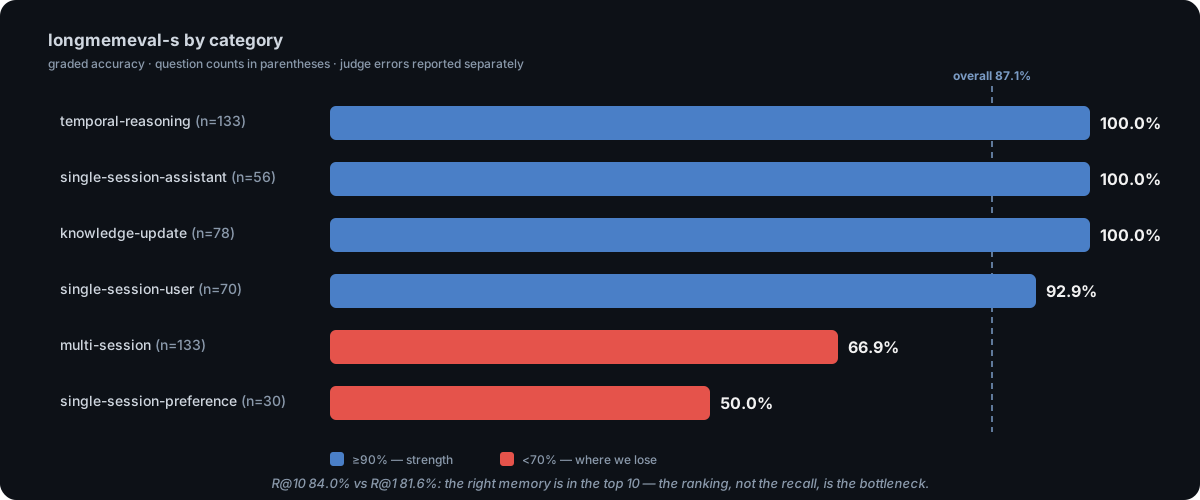
Per category, from the run JSON:
| Category | Accuracy | Questions |
|---|---|---|
| temporal-reasoning | 100.0% | 133 |
| single-session-assistant | 100.0% | 56 |
| knowledge-update | 100.0% | 78 |
| single-session-user | 92.9% | 70 |
| multi-session | 66.9% | 133 |
| single-session-preference | 50.0% | 30 |
The honest reading. We are at ceiling on the three categories that reward temporal bookkeeping and single-session lookup — what a temporal knowledge graph is built for. We are weak on single-session-preference (50.0%, n=30 — small bucket, read it with suspicion) and multi-session (66.9%, n=133 — the largest weak bucket, and the one that matters). The retrieval curve is the tell: R@1 at 81.6% versus R@10 at 84.0% says the correct memory sits in the top ten for nearly every miss. Recall is not the bottleneck. Ranking is.
3. Methodology, in full
Dataset. longmemeval_s_cleaned.json from xiaowu0162/longmemeval-cleaned. LongMemEval (Wu et al., ICLR 2025, arXiv:2410.10813) is 500 questions across five abilities, with roughly 115k tokens of haystack per question in the S variant. The full chat history is the retrieval problem.
No answer LLM in the loop. An earlier design graded an answer LLM’s output — the standard retrieve-then-generate-then-grade shape. We deleted that stage. The judge now sees the question, the retrieved context, and the ground-truth evidence, and grades retrieval directly: half the LLM calls, and a signal that measures the thing we actually changed.
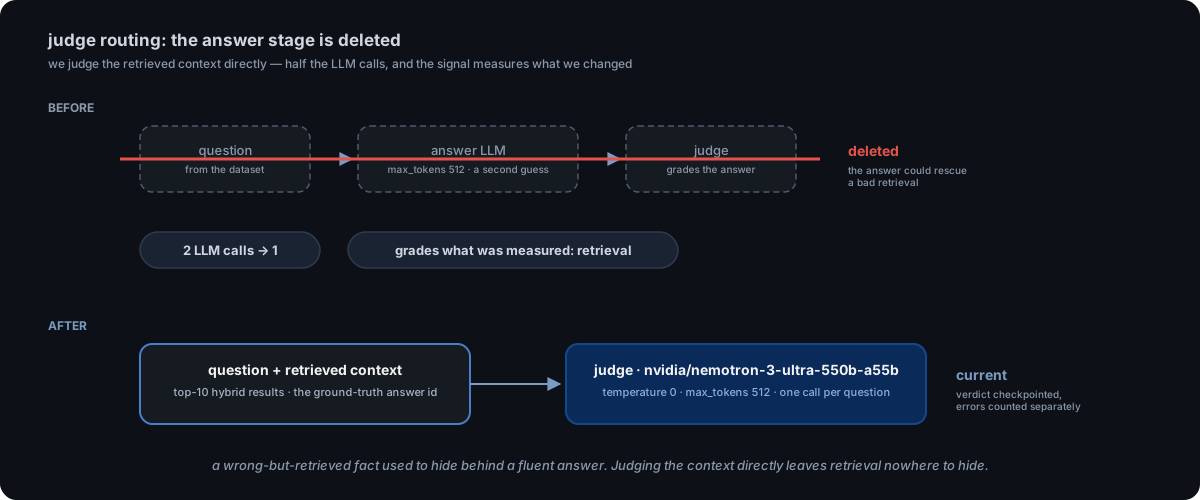
Judge. nvidia/nemotron-3-ultra-550b-a55b, temperature 0, max_tokens 512. One call per question.
Retrieval. Hybrid search over types=episodes,facts, limit 10; context limit 20. Reranker: off. This is the default stack, not a benchmark-assembled one.
Judge errors. Any question whose judge call fails is recorded as an entry and reported separately. The headline is fail-closed — an errored question counts as incorrect — and graded accuracy excludes errors so the two numbers are never silently blended. This run: 0 judge errors out of 500. We would rather print that line than bury it.
The results, in full. Every per-question entry — verdict, R@k, category, and reasoning — is published at benchmarks/results/longmemeval_s_20261010_051940.json in openzync-core, alongside the metrics and the run’s config fingerprint. Reproduce it with python -m benchmarks (or make benchmark). It needs a live instance and a judge API key — this is not an offline number.
4. The 2026 band
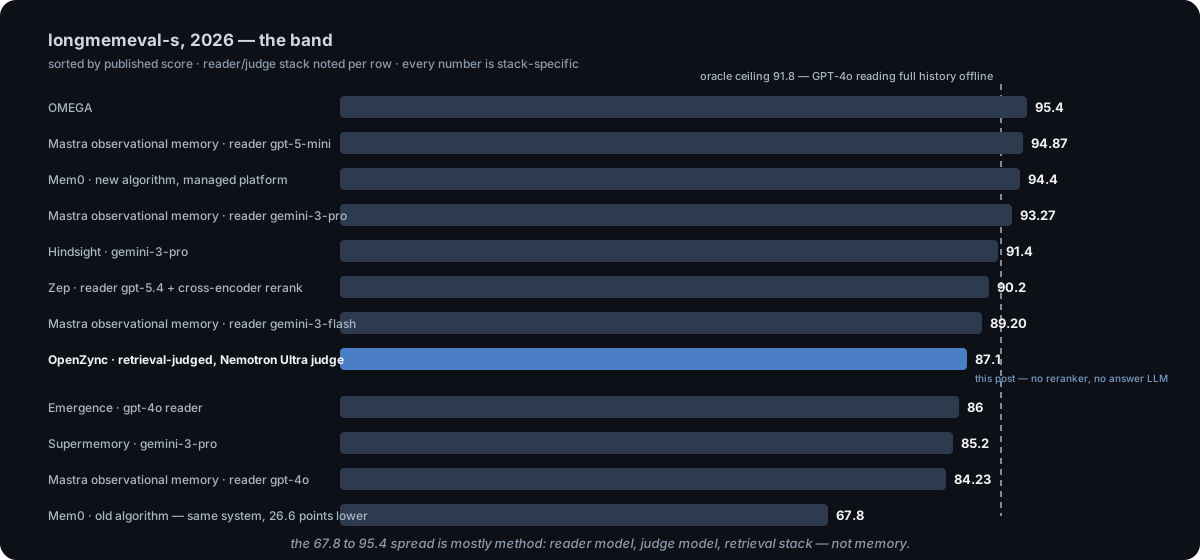
Where our 87.1 sits, with the published stacks:
- OMEGA: 95.4 (omegamax.co/benchmarks) — the top of the band
- Mastra Observational Memory: 94.87 with a gpt-5-mini reader, 93.27 with gemini-3-pro, 89.20 with gemini-3-flash, 84.23 with gpt-4o (cersei.tryatlas.cc/docs/bench-memory) — one system, 10.6 points of reader-model spread
- Mem0: 94.4 on the new algorithm (managed platform), 67.8 on the old algorithm (mem0.ai/blog) — same system, 26.6 points apart
- Hindsight: 91.4 (gemini-3-pro)
- Zep: 90.2 (451/500), reader gpt-5.4, cross-encoder plus multi-scope retrieval, 4,408 median tokens per question (getzep.com/research)
- OpenZync: 87.1 — Nemotron Ultra judge, retrieval-judged, no reranker (this post)
- Emergence: 86 (gpt-4o reader; their framing was 86 against Zep’s then-71.2 at comparable latency, emergence.ai/blog)
- Supermemory: 85.2 (gemini-3-pro)
- Oracle ceiling: 91.8 — GPT-4o offline reading of the full history, per the LongMemEval paper
The spread runs from 67.8 to 95.4, and most of it is method: which reader answers, which judge grades, how much context gets stuffed, whether a cross-encoder sits in the middle. Mem0’s old-versus-new comparison is the cleanest proof — the architecture did not become 26.6 points better; the pipeline did. Mastra’s four rows are the second: 10.6 points from the reader model alone. Everyone’s number is republishable only with their exact stack — hence the harness section below.
Two cautionary datapoints before anyone quotes a tier list. Omi’s 83.3% is on a 36-question oracle-variant subset, not the full S haystack — a different, easier benchmark wearing the same name. And M3 Memory’s published 89.0% comes with R@10 at 96.8%, a ±0.7pp reproducibility note, and a 6.4% no-retrieval floor — a sanity anchor for what a system should score by answering nothing at all. Our 87.1 is mid-band. That is the claim: mid-band, fully disclosed, weak categories named in the same post.
5. The harness
A mid-band number only means something if the harness is inspectable, so the harness is the actual deliverable here. Five properties, all in openzync-core:
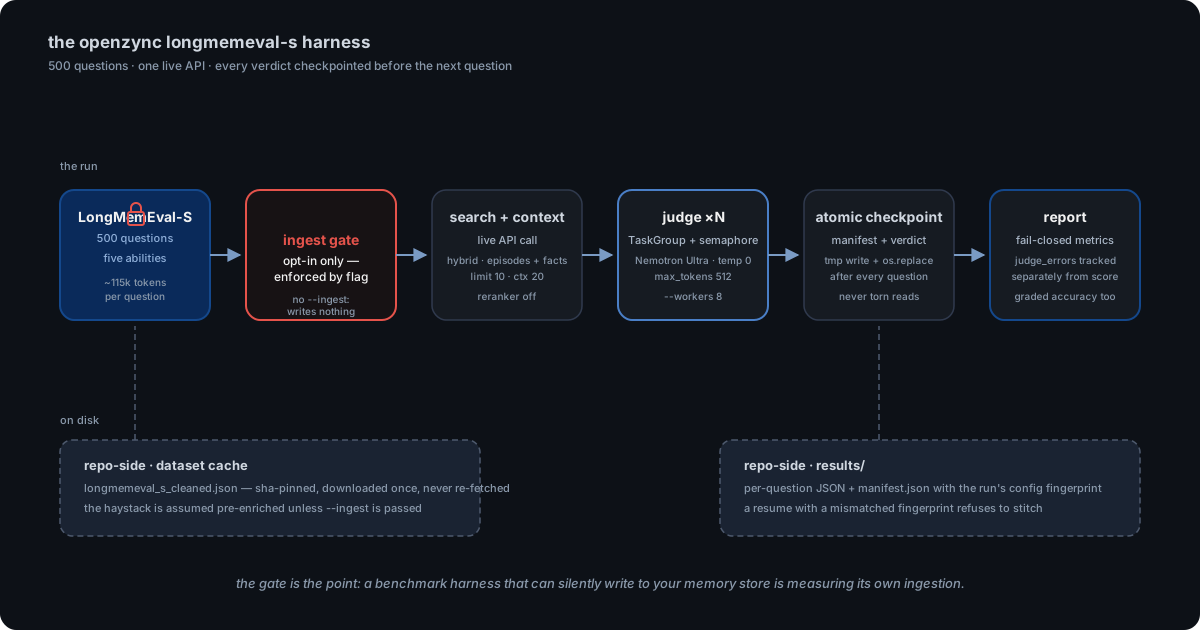
Ingest-gated by default. The harness never writes to your memory store unless --ingest is passed. The dataset is assumed pre-enriched, so a scoring run cannot silently mutate the thing it is scoring — a benchmark that can write to the store mid-run is measuring its own ingestion.
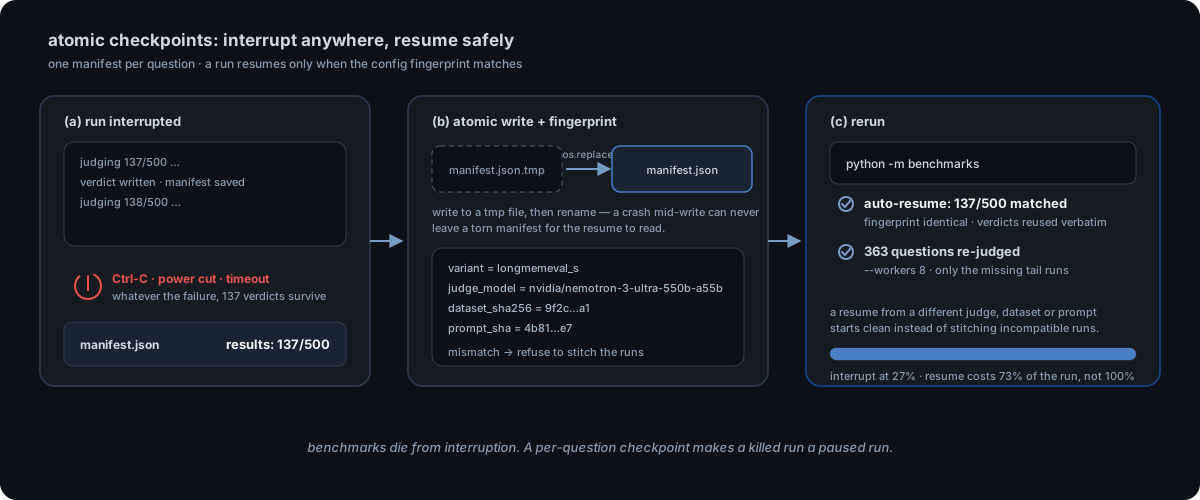
Atomic, fingerprinted checkpoints. Every question’s verdict lands in a per-question checkpoint manifest written to a tmp file and moved with os.replace — a crash mid-write can never leave a torn manifest. Each manifest carries the run’s config fingerprint: variant, judge model, dataset SHA-256, judge-prompt SHA. A resume with a mismatched fingerprint refuses to stitch incompatible runs; it starts clean instead.
Auto-resume. Ctrl-C, a power cut, or a killed worker costs you the questions in flight, not the run. The next invocation matches fingerprints, reuses matched verdicts verbatim, and re-judges only the missing tail.
Concurrent judging. --workers N fans judging out through a TaskGroup with a semaphore — identical verdicts, less wall-clock. Default is 1 for reproducibility; 8 is what this run used.
Fail-closed metrics. Judge failures are counted as judge_error entries, reported separately from the score, with a graded accuracy computed both ways. The fail-closed headline and the graded number are printed side by side; a run that hides its judge errors is not reporting metrics.
Reproduce:
make benchmark                          # single worker, fail-closed metrics
make benchmark ARGS="--workers 8"       # concurrent judging, identical verdicts
6. What we learned, what’s next
The judge is the measurement. We watched the judge failure rate go double-digit at points on one judge model while another stayed around 6%. A published metric without a judge-error rate is incomplete — a judge swap moves scores more than most architecture changes. Ours is 0/500 for this run; print it next to the score.
R@10 versus R@1 is a ranking problem, not a recall problem. The right memory is in the top ten almost every time. The reranker A/B is the obvious next experiment, and both flags already exist: --reranker to turn it on, --baseline for a pure-vector comparison run. The gap between those two numbers and this one is the actual roadmap item.
Publish the harness before the score. A number without a manifest is a press release. The per-question JSON, the fingerprints, and the commands above are in the repo before anyone quotes the 87.1 — that ordering is the point of this post.
Next: the reranker and baseline ablations (the --reranker and --baseline runs already exist in the harness), and a LongMemEval-M (1.5M-token) run to see whether the temporal graph holds up when the haystack stops fitting in anyone’s context window.
This is part of a series on agent memory. Read the benchmark-reality-gap post, then how a temporal knowledge graph is built, then OpenZync vs Zep vs Mem0, then why context windows aren’t memory.