
The fifty-turn wall is not a token problem
Late on a Thursday a 12-channel Discord flame war distilled a year of quiet frustration into one sentence — your agent was brilliant for thirty turns, competent at forty, and incoherent by fifty. Not because the model forgot how to reason, but because the harness around it had no place to keep what mattered while letting the rest fall away. The reflex is to buy your way out — a bigger window, a cheaper per-token line, a 2-million-token dump “just in case” — and a secondary summary of a fan reaction by Lisa Park on singularitymoments.com captured why that reflex fails with a line worth quoting verbatim because paraphrase would blunt it:
“dumping 2 million tokens of unformatted execution logs into prompt context is like trying to find your car keys by swallowing a map” — as attributed by a secondary summary of a fan reaction by Lisa Park on singularitymoments.com.
The map is not the territory and swallowing it does not make you oriented. The thread kept circling the same three observations — import errors that compound, tasks that get quietly dropped, context that gets evicted exactly when it is needed — and the same exhausted conclusion: dumping more tokens into the prompt is not memory, it is a larger haystack with the same lost needle. What the thread was really asking for, without naming it, was a harness that treats longevity as a first-class design problem — not a longer pipe, but a place where the right facts survive the next fifty turns because they earned their place there, and the rest are allowed to fall away without being mourned.
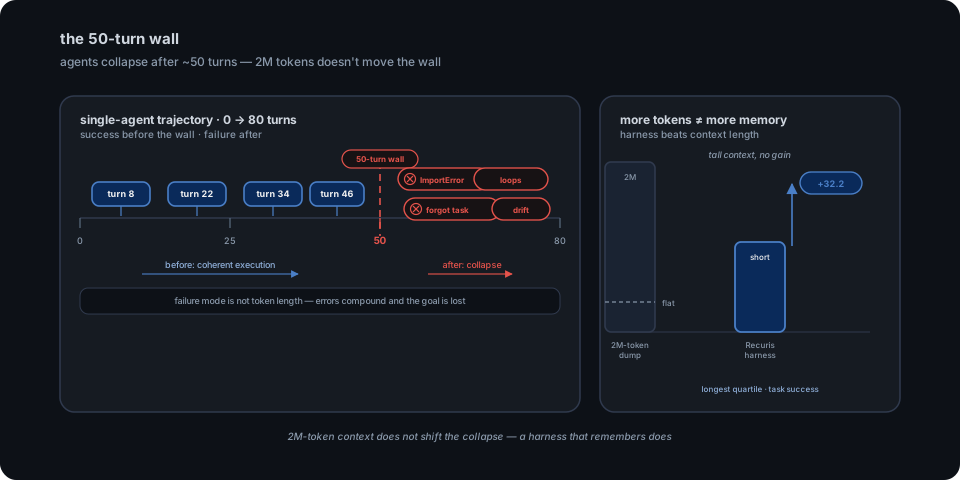
This post walks why that wall exists — why pouring a longer transcript into a longer window still collapses — what three August 2026 preprints, per authors and not yet peer-reviewed, measured about the collapse and its partial remedies, and what a durable shape looks like when you stop asking the window to do memory’s job. Every number below is per its paper’s authors — v1, August 2026 — with the hedge worn where the paper wears it, and with the tildes left where the authors left their own intervals.
Why bigger windows don’t fix it
Dumping is not remembering — and the window knows it. A 2-million-token prompt can carry fifty turns of logs, tool outputs, file reads, and half-finished plans without dropping a byte, yet agents fed that haystack still lose the thread where longer-horizon work finally matters. The reason, per authors across the three papers, is not capacity but curation — position bias that favors the recent, distractor overload that buries the load-bearing fact under verbose tool results, and no standing distinction between “what happened” and “what is still true.” The window ranks by nearness to the end, not by validity now, and a fact that was true at turn twelve and superseded at turn thirty-one competes as a neighbor with the fact that replaced it. Add two million tokens of unformatted logs and you have not added memory — you have added noise the model must re-parse on every turn, paying its token cost whether the next step needs it or not.
Fifty turns is where harnesses, not models, collapse. The flame-war anecdotes line up with what the preprints instrumented: early turns succeed because the relevant facts are still nearby; later turns fail because the agent must carry a growing pile of stale claims, overwritten plans, and once-correct tool outputs without a place to retire what expired. The symptom list is consistent across domains — forgotten multi-step goals, repeated tool calls that already succeeded, confident continuation from a state the environment left behind — and the longer the horizon the more often at least one of them appears. A bigger window does not retire the stale plan, does not quarantine the untrusted claim, and does not promote the recovered workflow — it just keeps all three, longer. Memory, in this picture, is not “more prompt” — it is a decision about what deserves to survive the next rewrite and what should be left to the log. The papers converge on that reframe from different angles — one as a skill-gating problem, one as a diagnosis problem, one as a spatial-cache problem — but the diagnosis underneath is the same: longevity fails at the harness, not at the model, and a longer window just moves the haystack without moving the needle. What compounds the failure is that the agent itself rarely notices the moment it slips — long-horizon traces in the papers show the model continuing with the same fluency after the wall as before it, only now fluent about a plan the environment already invalidated, or a file that no longer exists, or a constraint the user revised twenty turns back and the window never retired.
Recuris — a harness that remembers how it recovered
Two memories, one gate — and the gate is the paper. Recuris (arXiv:2608.24876), v1 August 2026, per authors, proposes a deliberately narrow shape: Working Memory that carries verified state, Experiential Memory that carries retrieved skill, and a fixed Meta-Agent that gates every candidate skill on validation before it is ever stored — Eq. 9 in the paper. Nothing is promoted because it was salient at extraction time — it is promoted only because a validation run, per authors, reproduces the recovery and earns the write. The paper pairs that design with wins that are modest on average and striking where length hurts most, and both need to be read with the Table 1 hedge — averaged over four runs per pair with paired bootstrap confidence intervals, not single-shot point scores.
Headline scores with their tildes intact. As reported per authors, 35 of 37 model–bench pairs improved overall; the two that did not are part of the claim, not a footnote to it. GPT-5.6 Sol on tau-bench moves from 58.3 to 76.1, a gain of ~17.8 points, per authors; Opus 5 on the same suite moves from 72.4 to 87.9, a gain of ~15.6 points to an ~87.9% total, per authors. The SkillFlow deltas read similarly — Qwen3.6 at 27 billion parameters from 42.2 to 58.7, a gain of ~16.6, and at 35 billion from 35.3 to 48.8, a gain of ~13.5, per authors — which matters because the paper frames Experiential Memory as a skill-retrieval store, and SkillFlow is its riding test. Each of those deltas is hedged with a tilde because the paper itself hedges them — four runs, bootstrap intervals, and a construction cost that the next section prices honestly rather than burying.
Where length hurts, the lead widens. The paper’s Fig. 4 is the number this post treats as the headline, not the average — per authors, the longest quartile lead over the baseline widens to ~plus 32.2, and the gains across quartiles run from ~17 to ~44.7, per authors. That is not “Recuris wins longer tasks” — it is “Recuris wins more where harnesses otherwise collapse,” which is exactly the wall from §1 priced in points. Common long-horizon failure modes, per authors, fall by ~80% — a large number that deserves its own hedge, because it aggregates categories where a prevented class can drop sharply from a small baseline — and the paper reports the improvement alongside the construction it required. Recuris is not a longer window. It is a ruled harness — verified state plus validated skill, with admission explicitly gated — and per authors its advantage compounds with horizon rather than fading with it.
The cost of learning from mistakes
Every validated skill has a bill — and the skeptics priced it before the authors did. Validation-gated admission, per authors, means extra LLM calls per candidate skill — generate the skill, run the validation, keep it only if the run reproduces. The paper does not hide that shape and neither should its readers. Reddit skeptics flagged the same line the paper’s own table implies: more calls per promotion, more latency per write, higher construction spend for a gain that only amortizes if the workload revisits the pattern. Per authors’ own framing, validation is the price of not storing the model’s confident lies — and the community reply is the right question to ask alongside the headline — does the ~plus 32.2 on the longest quartile buy back the calls it spent getting there? The skepticism is healthy precisely because the paper makes it legible — every skill pays at write time so that every future read does not have to re-learn the same recovery, and that accounting only balances when the future actually arrives.
The trade is reliability, not raw tokens. The honest read is to price cost against the failure it removes, not against a cheaper prompt that would have failed anyway. A skill that was never validated — extracted because it was salient, stored because it embedded closely — is the kind of write the poisoning and confabulation posts in this series warned about: persistence that keeps the claim while erasing the constraint on its use. Recuris, per authors, buys its way out of that trap with explicit validation before any promotion — and the per-call cost lands on the write path, once, rather than on the serving path forever. The hedge is load-bearing — the workload decides whether that bill is wise. A short-lived agent that never revisits a pattern pays the construction and never earns the retrieval; a long-lived agent that solves the same class of faults fifty times amortizes it quickly. The paper’s own longest-quartile widening is that amortization made legible — per authors, the gain grows where horizon grows — which is another way of saying the bill only becomes cheap when the wall it fixes is tall enough to matter. Teams that ship short evals will rightly call the construction expensive; teams that ship agents that live through fifty turns and then through fifty more will recognize the price as the cheaper of the two failures. That framing also explains why the skeptics and the authors agree on the numbers and disagree only on the workload — the cost is not hidden, it is priced per promotion so the team can decide whether the pattern is worth keeping.
LongRCA — why diagnosis is harder than fixing
Fixing feels easy because finding the crack is hard — and root-cause analysis on agents is a long-horizon problem in its own right. LongRCA (arXiv:2608.15242), v1 August 2026, per authors, builds the benchmark the flame-war thread was asking for without knowing it: 1,140 failed trajectories, five domains — SWE-Pro, T-Bench2, TravelPlanner, VitaBench, WebArena Verified — median length 145 steps, mean ~156.3, maximum 728. Those lengths are the wall re-measured in steps rather than turns — trajectories long enough that a single wrong tool call at step forty can surface as a failure at step two hundred, with a hundred plausible intermediates between them. Any benchmark that stops at thirty steps will never see that fault; LongRCA exists because the wall is taller than most evals bother to measure.
The baseline collapse is the argument. All baselines in the paper, per authors, run on DeepSeek-V4-Flash, and the best baseline the authors report, ECHO, lands at ~13.2% exact root-step accuracy — the share of failures where the model names the precise step whose fault explains everything downstream. That number is not a weak-model artifact — it is the shared ceiling of agents asked to diagnose long failures without a harness shaped for diagnosis. The authors’ RCTA approach, per authors, moves that ceiling to ~51.1% responsible-role and ~24.1% exact-step accuracy, with ~37.4% within plus-or-minus five steps. The delta that matters is ~13.2% to ~24.1% on the exact step — the slice where attribution must be precise — and ~51.1% where it must at least name the right actor. Both are reported per authors, not yet peer-reviewed, and both keep the same hedge as §3 — this is measurement, not law, and a reminder that a benchmark that names the wall at a median of 145 steps is only useful if teams actually run it at that length rather than truncating the traces to fit a cleaner eval.
Diagnosis, not correction, is the eval the field needs next. The paper’s contribution is less the method than the ruler — long-horizon failure attribution as an evaluated dimension — and the ruler matters because correction without attribution scales poorly. An agent that re-tries a failed plan without knowing which step poisoned it will retry the wrong step, and the wall gets taller by the retry. The signal to carry out of LongRCA is not the method’s score but the diagnostic one — per authors, naming the precise failure step roughly doubles over the best baseline and responsibility assignment roughly quadruples, which is exactly the kind of capability a validated-skill harness like Recuris would need to decide what to gate at Eq. 9. Without that diagnostic signal, every “learned skill” is a guess about what should have been learned — and guesses, stored without validation, are the confabulations the governance loop in §7 is designed to prevent.
ReWorld — the same problem in space
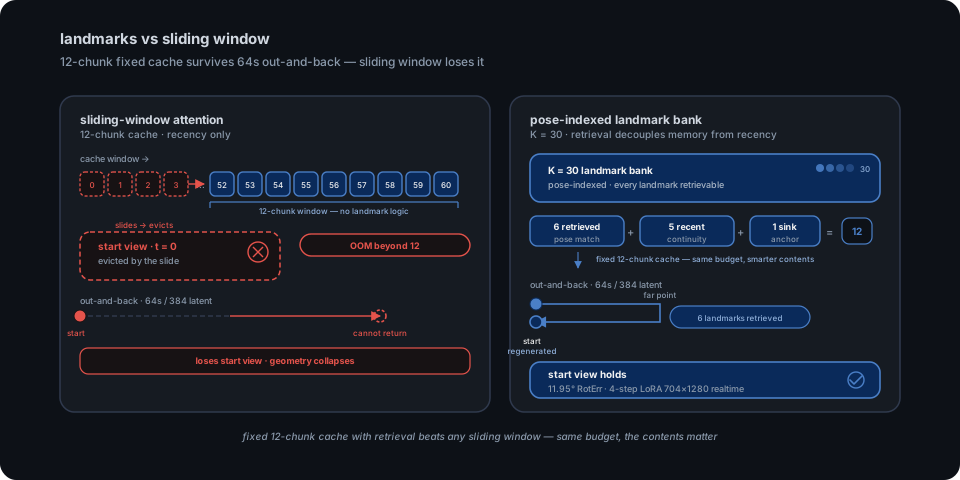
The window problem has a spatial twin — and it looks like a memory cache. ReWorld (arXiv:2608.23565), v1 August 2026, inception date 16 Aug 2026, per authors, describes an interactive world model whose long-horizon failure is architecturally identical to the agent wall — a transformer that must stream 704-by-1280 frames in real time cannot carry every prior frame forever, and how it chooses the frames to carry decides whether a walk that leaves a place can later recognize it on the way back. The paper’s answer is a fixed, pose-indexed landmark bank — B equals 12 chunks total, per authors — one sink, five recent, six retrieved by field-of-view overlap from a bank of K equals 30 landmarks, Eq. 3 in the paper — fused with a mixed sliding window that keeps temporal coherence while the landmark retriever keeps spatial coherence. The bank is routing-aware memory under another name — a small set of frames chosen not because they are recent, but because their pose overlaps the pose you are asking about.
One number anchors the claim — with its units attached. Per authors, ReWorld reports ~11.95 degrees overall rotation error — RotErr — as its best control-fidelity number, the metric the paper foregrounds for faithful world-model control. The efficiency shape matters alongside it — per authors, four denoising steps via rank-128 LoRA distillation and streaming 704-by-1280 generation in real time — because a landmark bank that only helps at thirty seconds per frame is not a harness. The demonstration the paper chooses is the wall test in physical form — per authors, a 64-second, 384-latent out-and-back trajectory where the model leaves the starting view, travels outward, and returns — the sliding window has evicted the start by the time it is needed and a full key-value cache would have already exceeded memory, while the landmark bank, per authors, still regenerates the starting view because an overlapping landmark survived the route.
Twelve chunks is the design knob. That the budget is fixed — twelve, not “as many as fit” — is the architectural parallel to the governance loop the next section reuses — a small, typed cache whose size is a governed choice, not a spillover default. Six retrieved landmarks out of thirty, plus five recent plus one sink, is twelve decisions about what deserves to be carried, and per authors those decisions are how a 64-second walk coheres where an unbounded window would have drowned. The wall is the same wall — time and space are just different axes — and the fix is the same discipline: carry less, choose with intent, retrieve by pose rather than recency. What makes the paper travel beyond its domain is that twelve-chunk discipline — a fixed bank that survives a 64-second out-and-back is the spatial proof of the temporal claim Recuris makes with its gated skill store, and both point at the same harness principle: a small cache governed by relevance outlasts a large window governed by recency, and the difference only shows up where the horizon is long enough to punish the alternative.
The synthesis — route and validate before promotion
Route the write, then validate the promotion — no claim becomes knowledge by being near the query. The three preprints agree on the shape even though they attack different axes — Recuris by validated skill promotion, LongRCA by attribution before correction, ReWorld by landmark retrieval before generation. Each replaces “keep everything recent” with two disciplined steps — route the candidate to the store whose lifecycle matches its standing, then validate it before it is allowed to persist. Classification is the write-time decision — ephemeral context stays in the window, episodic history is stored with writer and time, durable truth is stored with provenance and validity, and validated workflow is stored only with a gate. Write rules encode the price — every promotion pays on the write path to avoid taxing every future read — and routing at query time decides which store to ask for the kind of question actually posed. The corollary is that retrieval is not a single ranked list — it is a routed decision where the question shape determines the store, and the store’s standing determines whether the answer is treated as history, as durable truth, or as a workflow that earned its place through validation.
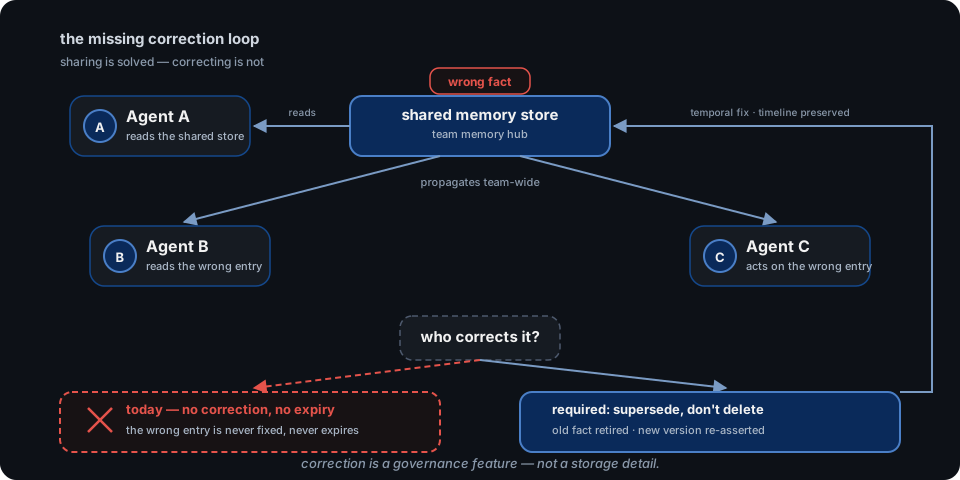
A harness is only as good as the store it promotes into. The synthesis above needs a persistence layer that can carry the distinctions the gates decide — a fact that knows where it came from, when it holds, what it superseded, and who may use it — so the router has something to route on besides nearness. That is the design space OpenZync occupies, stated at the level tone this series has kept for nineteen posts: a self-hostable temporal knowledge graph where facts supersede rather than overwrite, with provenance and validity windows carried alongside every claim — a routing-aware persistence layer that treats promotion as governance, not as an embedding side effect. It claims no benchmark scores — per authors and not yet peer-reviewed is already the hedge for every number on this page, and that standard does not change when the system named is ours.
The decision table
The honest guide to the layer, read as jobs rather than products — and read with every paper’s “per authors, not yet peer-reviewed” hedge intact:
| Approach | Best at | Fails at | Build when |
|---|---|---|---|
| Raw dump — 2M unformatted logs in prompt | Zero plumbing, maximal recall surface | Distractors, position bias, stale truths as neighbors — no supersession, no gate | Demos and short evals that never cross the wall |
| Recuris-style harness — verified working state plus validation-gated skills | Recovering from faults and reusing validated workflows — per authors ~plus 32.2 on longest quartile | Extra LLM calls per validation — latency and cost before any promotion | Long-horizon agents that revisit failure classes |
| RCTA diagnosis — root step attribution | Naming the responsible role and the exact failing step — per authors ~51.1% / ~24.1% | Still misses exact step often — attribution is not correction | Ops and eval where who failed where matters more than the patch |
| Routed multi-store — typed memory with a router | Right cost for the right fact — hot truth in window, history on demand, workflows gated | More moving parts — classification, routing, and validation to operate | Any multi-session agent where facts have different lifespans and permissions |
| OpenZync | Temporal knowledge graph — supersede-not-overwrite with provenance and validity windows | Routing still operated by the team — no benchmark scores claimed | Provenance and audit matter — facts must know where they came from and what they replaced |
Read the rows against the wall, not the feature list. Row one never clears the wall — it builds it taller. Row two pays on the write path to clear it on later revisits — per authors, the lead widens where the horizon does, and the ~80% drop in common failure modes is the visible side of that widening. Row three makes the miss attributable — per authors, ~13.2% to ~51.1% and ~24.1% exact — so the gate in row two knows what to validate, and ~37.4% within five steps gives the reviewer a place to start even when the exact step is missed. Row four names the perpetual job underneath — routing by standing — and row five, like every table in this series, offers a persistence shape for row four without claiming a score the benchmarks above did not give it. The table is a lens, not a leaderboard — its value is that it makes the cost of each choice legible before the team pays it in production at fifty turns and beyond.
What to watch
Three signals will mark where this lands — none of them is a product announcement, all of them are evidence — and each is stated with the hedge the source requires.
Working-memory harnesses become a substrate. The next generation of harnesses, per authors, will read like Recuris — two memories and a gate — not like a longer pipe. Working Memory that carries only verified state, Experiential Memory that carries only validated skill, and a fixed, composable policy at admission that does not itself need retrieval to decide — Eq. 9 as idiom rather than as single paper. Watch for that idiom moving from paper to scaffold, and for the pre-registration the field still needs — Table 1 in Recuris is averaged over four runs with paired bootstrap intervals, and that discipline should survive the port. The test will be whether teams adopt the two-memory shape without the gate — carrying verified state but skipping validation — and learn the same lesson Recuris priced explicitly: a skill store without a gate is a confabulation store with a nicer name.
Failure attribution becomes an eval dimension. LongRCA’s lasting contribution, per authors, is the benchmark that makes attribution a leaderboard, not just accuracy on the happy path. Five domains, 1,140 trajectories, median 145 steps — the wall measured as a ruler — with exact-step and plus-or-minus-five as forgiving gradations and responsible-role as the coarse check. The evolution of agent evals has been flat up to now because diagnosis had no score — watch for sweeps where an agent that fixes less but attributes more is judged healthier than one that patches blindly. The same shift would make the Recuris gate auditable — per authors, RCTA at ~51.1% role accuracy is not yet reliable enough to automate promotion, but it is already good enough to triage which validations are worth running first.
Twelve-chunk fixed caches become a pattern. ReWorld’s B equals 12, per authors — one sink plus five recent plus six retrieved from thirty — is a small number for a large consequence. Fixed-size, pose- or query-indexed banks that survive long traversals where unbounded caches overflow are the spatial cousin of the temporal gate. Watch for that fixed-bank idiom spreading — to episodic retrieval that indexes by task pose rather than recency, to hybrid windows that mix temporal and retrieval coherence, and to interactive systems where a 64-second out-and-back is the minimum bar because users actually walk that far without noticing the retrieval happening underneath. Per authors, the 64-second, 384-latent demonstration is not a contrived stress test — it is the shape of real use, where a user leaves a place, does other work, and expects the start to still be there when they return, and where a sliding window that evicted it cannot be patched by making the window a little longer.
The memory your window can’t carry
The uncomfortable correction of this post is not that windows are small. It is that a window, however large, answers the wrong question — “what fits?” — when the agent’s actual questions are “what is still true?”, “who may use it?”, “what replaced it?”, and “what happened at the step that explains this failure?” Dumping two million tokens into the prompt preserves the haystack and hides the key the way swallowing the map preserves the paper and hides the car. The three August 2026 preprints, per authors and not yet peer-reviewed, converge on the same correction — keep less, route with intent, validate before promotion — and price it three different ways: per authors, ~plus 32.2 where the wall otherwise stands tallest, ~13.2% to ~51.1% on naming who failed and ~24.1% on naming where, and ~11.95 degrees of rotation error with twelve chunks carried for sixty-four seconds. Each number is hedged where the paper hedges it, and each will move with the next run.
OpenZync is a self-hostable temporal knowledge graph where facts supersede rather than overwrite, with provenance and an audit trail carried alongside every claim — the persistence a window can’t provide, and a starting point for routing-aware memory. Start with the memory & context docs and the openzync-mcp repository.
This is part of a series on agent memory. Read why context windows aren’t memory, then how a temporal knowledge graph is built, then the honest map of agent memory tools, then the five patterns of graph memory, then the MCP memory-server field guide, then when agents talk to each other, who remembers, then the new attacks on AI memory, then team memory and who fixes a wrong fact, then the gap between benchmark scores and agentic memory, then what happens when agents remember things that never happened, then your agent doesn’t need a knowledge graph, it needs a search box, then context engineering won’t fix your agent’s memory, then everyone ships an llms.txt, almost no agent reads it, then your agent’s memory file is how mind viruses spread, then MCP and A2A have a foundation now, then the right to be forgotten meets agent memory, then cheap memory is the expensive option, then your RAG pipeline is not how ChatGPT remembers you, then the post that started it all.