
Agents were built to remember. Regulators noticed.
Agent memory was engineered around a single economic assumption: keeping everything forever is free. Storage costs fell for decades, so every layer of the stack optimized for accumulation — harnesses that append to a memory file instead of rewriting it, memory servers that consolidate conversations into durable facts, vector stores that embed every turn because embedding is cheaper than deciding. Retention was the feature. Forgetting was the bug. Nobody shipped a delete button because nobody’s benchmark asked for one, and nobody’s benchmark asked for one because the assumption said none was needed.
European law has now removed that assumption, and it removed it from two directions at once. The GDPR’s right to erasure and its storage-limitation principle have applied since May 25, 2018 — old law, but newly pointed at a new target. And the EU AI Act’s data-governance and logging duties began applying this August, as currently enacted, reaching the same layer from the other side: not “delete what you hold” but “govern what your system learns from and log what it does.” One regime asks an agent’s memory to forget on demand. The other asks it to account for everything it kept. Both assume the store can answer questions most agent stacks were never built to answer.
The compliance surface this creates is real and mostly unsized. Writing on May 26, 2026, agentmodeai.com put the gap precisely: “Identity governs who the agent is; eval governs whether it is right; nobody is governing what it remembers, where that memory lives, and how long it persists.” Identity has frameworks. Evaluation has benchmarks. Memory — the layer that accumulates everything a user ever said, distilled into facts the agent will act on for months — has legal pressure arriving faster than governance architecture.
One line before the deep end: this post is engineering commentary, not legal advice. The legal questions belong to lawyers. The architecture question belongs to engineers, and it is unavoidable either way, because deleting one fact from an agent’s memory turns out to mean chasing it through raw transcripts, derived embeddings, regenerated summaries, and — at the far edge — model behavior itself.
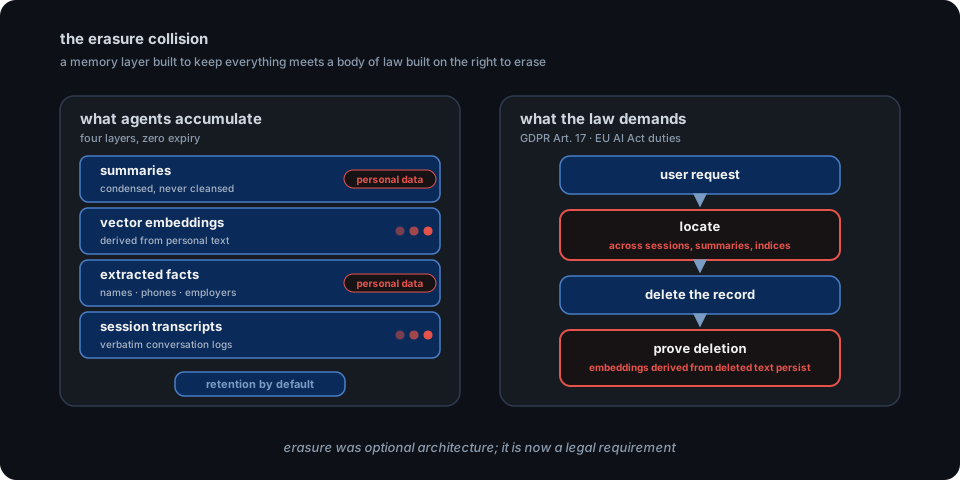
This post walks the collision end to end: what the two regimes actually require, why agent memory breaks their assumptions, why deletion is the hardest operation in the stack, and what an architecture that survives an audit looks like. The synthesis compresses to one line, and it is this series’ argument wearing different clothes: provenance, supersession, and authority stop being engineering virtues and become compliance prerequisites — a memory that records where every fact came from is the only memory that can be audited, and auditability is what the law now asks for.
What the law actually requires
Start with the GDPR. Its erasure right lives in Article 17, officially titled “Right to erasure (‘right to be forgotten’),” and the core obligation reads: “The data subject shall have the right to obtain from the controller the erasure of personal data concerning him or her without undue delay and the controller shall have the obligation to erase personal data without undue delay.” It is a qualified right — exceptions cover freedom of expression, compliance with legal obligations and public-interest tasks, and the establishment, exercise, or defence of legal claims — but the default direction is unmistakable: erase, without undue delay, when nothing overrides. And the duty does not stop at your own database. Article 17(2) requires “reasonable steps, including technical measures” to inform other controllers that links to, copies of, or replications of the personal data have been erased. Erasure propagates, or it is not erasure.
Two principles give the right its teeth. Storage limitation, Article 5(1)(e), permits keeping personal data only “in a form which permits identification of data subjects for no longer than is necessary for the purposes for which the personal data are processed” — retention needs a purpose and a clock, not a default. And accountability, Article 5(2), requires that the controller “be able to demonstrate compliance” — the burden is not merely to comply but to prove it, which is why Article 30’s records of processing activities exist. The locate-and-prove burden has a legal home, and it has had one for eight years.
The stakes sit in the top fine tier. Article 83(5) sets penalties at “up to 20 000 000 EUR, or in the case of an undertaking, up to 4 % of the total worldwide annual turnover of the preceding financial year, whichever is higher” — €20 million or 4% of global annual turnover, whichever is larger — and violations of the data-subject rights in Articles 12 through 22, erasure included, fall inside that tier.
Now the AI Act, whose application schedule matters as much as its text. The regulation was published in the Official Journal on July 12, 2024 and entered into force on August 1, 2024. Prohibitions and AI-literacy duties applied from February 2, 2025; general-purpose AI obligations, governance, and penalties from August 2, 2025. On August 2, 2026, the remainder of the AI Act starts to apply, except Article 6(1), which follows on August 2, 2027 — and as currently enacted, that remainder includes the Annex III high-risk obligations, among them Article 10 on data governance and Article 12 on record-keeping. One hedge belongs next to every hard sentence about that date, and here it is: a pending amendment — provisional agreement reported May 7, 2026, not yet adopted at writing — would defer the stand-alone Annex III high-risk obligations to December 2, 2027. The dates above are the law as it stands; the deferral is a proposal with momentum. Plan against the enacted text and watch the amendment.
The two articles that reach memory are concrete. Article 10, “Data and Data Governance,” requires that training and validation data be “relevant, sufficiently representative, and to the best extent possible, free of errors and complete in view of the intended purpose,” and that data-governance practices include “examination in view of possible biases” along with “appropriate measures to detect, prevent and mitigate possible biases.” Article 12, “Record-Keeping,” requires that “High-risk AI systems shall technically allow for the automatic recording of events (logs) over the lifetime of the system.” Read those against an agent that learns from its own accumulated memory and the shape of the requirement comes into focus: the data the system learns from must be governed, and the system’s life must be logged — automatically, over its lifetime. Whatever the high-risk category ends up covering after the omnibus settles, the direction of both articles is the same, and it points directly at the memory layer.
Why agent memory breaks the assumptions
Agent memory is accumulation by default, and the accumulation is not incidental — it is the product. A memory server that forgot would be failing its benchmark. A harness that pruned its memory file aggressively would be losing the continuity users pay for. A vector store that declined to embed turns containing personal detail would be degrading recall on exactly the queries that matter most. Every incentive in the architecture points toward keeping more, keeping longer, and keeping it findable. The GDPR’s question — is this identification-permitting form still necessary for its purpose? — is asked nowhere in the pipeline, because no stage of the pipeline was given a vocabulary for purpose or necessity.
Personal data enters through the door the architecture holds open. As atlan.com’s July 6, 2026 guide to GDPR for AI agents observes, PII reaches these systems through the context layer — the documents, tickets, chat histories, and working notes fed in to make the agent useful — not merely through what a user types into a prompt box. A support agent ingests a customer’s complaint verbatim. A coding agent absorbs a credential pasted into a debugging session. A sales agent consolidates a prospect’s objections into a durable preference profile. None of that required anyone to decide to store personal data. The context layer is the product, and personal data rides in with the context.
Retention defaults do the rest. Harness memory files persist across sessions by design; consolidation pipelines distill conversations into summaries meant to outlive the conversation; vector indexes keep every embedding until someone runs a reindex. Expiry semantics — a fact that retires itself when its purpose lapses — exist almost nowhere in the mainstream stack, because the founding assumption said time was not a variable that mattered.
Which reduces the compliance problem to three operations the average stack was never designed to perform: locate every copy of a fact, delete it everywhere it lives, and prove both happened. Most stacks fail at the first operation — not because deletion is slow, but because nobody drew the map. You cannot chase a fact through a system that never recorded where it put anything.
The provability gap
The hardest version of the problem has been formal for years. Bourtoule et al.’s “Machine Unlearning” (arXiv:1912.03817, IEEE S&P 2021) states it plainly: “any model trained with said data may have memorized it… having models unlearn is notoriously difficult.” The paper’s baseline comparison is the telling part — the ground truth for “did we forget correctly?” is retraining the model from scratch without the data, an operation defined as the cost ceiling everything else is measured against. Machine unlearning research exists because the ceiling is usually unaffordable.
Below the model, deletion fails to propagate through derived representations. Delete the transcript row and the embedding computed from it remains in the vector index — a lossy but faithful derivative of text that no longer officially exists. Regenerate a summary after deletion and the summary is clean; regenerate it before deletion, or never regenerate it at all, and the deleted fact survives in compressed form, stripped of the very context that would make it findable. The research note that named this condition — perea.ai’s May 2026 “Right to Be Forgotten in Agent Memory: GDPR + CCPA Architectures for 2026” — calls it “the embedding-deletion provability gap”: you cannot prove a derived representation is gone, because you cannot enumerate everything the pipeline derived.
And the obvious escape hatch — retrain the model, the summaries, the index from clean data — collides with economics. Stanford HAI’s 2024 AI Index estimated GPT-4’s training compute at $78 million and Gemini Ultra’s at $191 million. Those are frontier-class training costs, and incremental retraining of smaller artifacts varies widely — but the order of magnitude explains the industry behavior: teams do not retrain to forget. They retrain to improve, on a schedule set by product roadmaps, and treat forgetting as something that happens between versions, if at all.
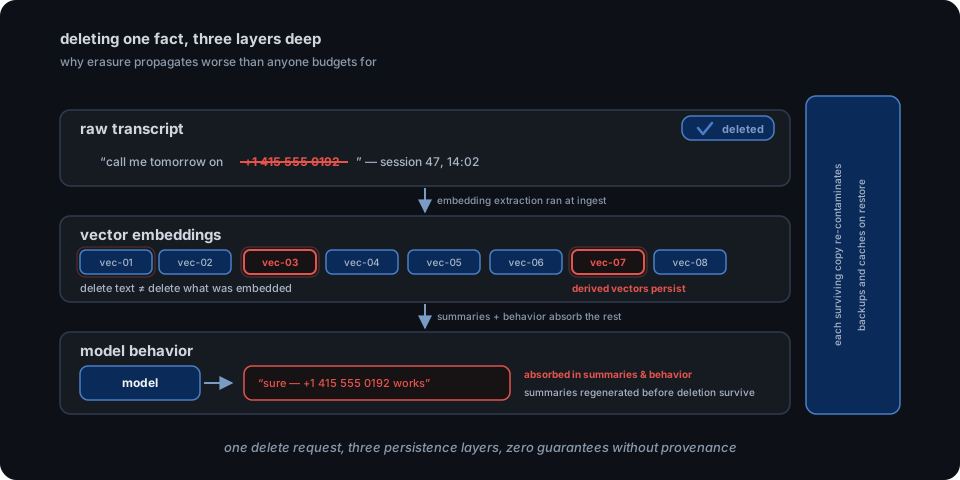
If retraining is off the table and deletion does not propagate, the remaining strategy is architectural, and it precedes any request: know where every fact lives, what was derived from it, and when it is scheduled to die — before anyone asks. Which is a mapping problem, and mapping has its own legal home.
The data-mapping problem
Accountability converts deletion from an operation into a demonstration. Article 5(2) requires the controller to “be able to demonstrate compliance,” and Article 30 requires records of processing activities — what categories of personal data exist, for what purposes, shared with which recipients. Together they mean the locate step is not optional diligence; it is a documented inventory the controller is expected to maintain. When an erasure request arrives, the question “where is this person’s data?” is supposed to have a maintained answer, not a scavenger hunt.
The UK ICO’s right-to-erasure guidance extends the map underground: erasure must reach backup systems, with backed-up data put “beyond use” where outright deletion is impractical, and recipients of the data must be informed. Backups — the layer every agent stack has and none of them maps — are inside the perimeter. So is everyone the data was ever shared with, which for agent memory can mean every integration, export, and downstream index the store has fed.
Secondary coverage has converged on the same diagnosis from the practitioner side. astraea.law’s April 12, 2026 piece is titled “You Cannot Delete What You Do Not Know the Agent Stored: The Memory Tool’s Privacy Problem,” and the title is the entire thesis: the failure mode is epistemic before it is operational. Deletion tooling presupposes a map, and agent memory is the least-mapped layer in the stack.
Because agent memory is not a store — it is a fan-out. The same fact lives in the session transcript, in the distilled summary, in the extracted entity graph, in the vector index, in whatever export or cache a downstream integration consumed this week. Each location has its own lifecycle, its own owner, often its own infrastructure. A team that can answer “what does the agent remember?” has usually answered “where is it stored?” for exactly one of those locations. The others are not hidden maliciously; they were never inventoried, because nothing required an inventory until the law arrived at this layer. The records Article 30 asks for are not a document about one database — they are a census of every place a fact was copied, derived, or distilled, and most teams have never run that census over their agents at all.
Why this flips the series’ argument into law
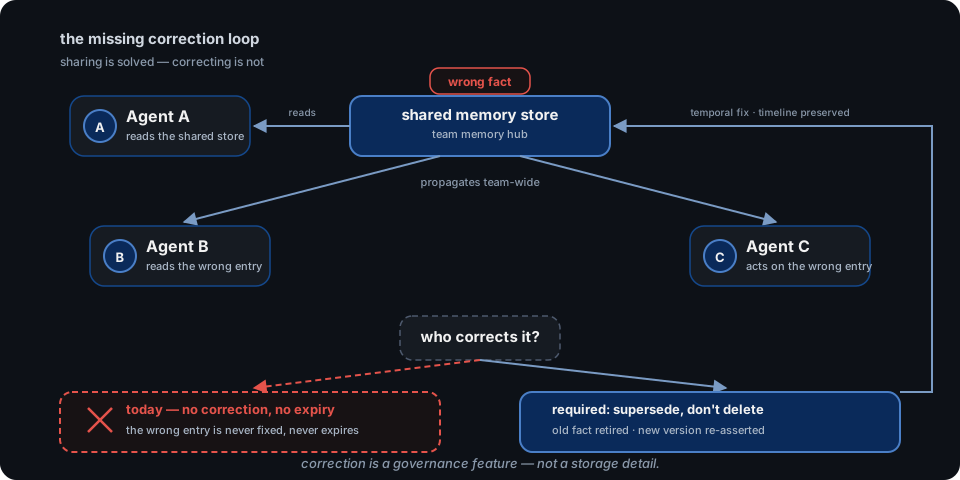
This series has spent sixteen posts arguing for three properties on engineering grounds. Provenance: where did this fact come from — the difference between an observed fact and a contaminated one, the lesson of the new attacks on AI memory. Supersession: what replaced it — corrections that retire a claim visibly instead of letting contradictions compete. Authority: who may use it — which writers may touch which records, and which readers may act on them. Every post found the same triad load-bearing, and every post had to argue against the grain of an industry shipping memory without them.
Under an erasure duty, the argument stops being an argument. Provenance is how you locate what a fact was derived from and what was derived from it — the map Article 30 asks you to maintain. Supersession is how a correction propagates without destroying the history an audit needs — the mechanism that lets a fact retire while the record of its life stays queryable. Authority is how you know which memories a given downstream system consumed, so that Article 17(2)’s recipient-notification duty has a recipient list to run against. The three properties were virtues when the only judge was correctness. They are prerequisites now that the judge can levy 4% of turnover.
Persistence without provenance is the failure mode this series documented most vividly: your agent’s memory file is how mind viruses spread showed payloads surviving every wipe because the carrier was the persistence mechanism itself. Under an erasure duty, that survival stops being a security curiosity and becomes a liability with a statutory name — the fact you cannot locate is the fact you cannot erase.
There is a fourth edge worth naming, because agents blur it. Article 22 of the GDPR governs automated individual decision-making: a qualified right not to be subject to “a decision based solely on automated processing, including profiling, which produces legal effects concerning him or her or similarly significantly affects him or her” — qualified because contract performance, legal obligation, and explicit consent carve out exceptions, and human-intervention safeguards attach. An agent acting on remembered personal data — denying, pricing, ranking, recommending — walks toward that boundary with every autonomous step, and the memory it acts on is the decision’s input record. Whether a given deployment crosses the line is a lawyer’s question; that remembered data sits upstream of consequential decisions is an architect’s certainty.
And the layer still has no standard to carry any of this. The protocol consolidation left memory outside every specification — MCP and A2A have a foundation now; memory still has no standard — so provenance, supersession, and authority remain fields each vendor invents privately or omits entirely. The law now asks the memory layer questions the layer has no common vocabulary to answer. That collision between legal duty and absent standard is the market opening this post is about.
Architecture that survives an audit
The remediation menu is taking shape, and credit where due: perea.ai’s May 2026 note lays out the engineering options — write wrappers that tag personal data at entry time, external indices kept separate from models so data can be purged without touching weights, deletion APIs exposed as first-class operations, and pre-use notices that tell users what will be retained before they generate it. Add expiry semantics — facts carrying their own retirement dates — and the menu becomes a design checklist. None of it is exotic. All of it is retrofitting onto stacks that assumed none of it would be needed.
Regulator guidance fills in the hard cases. France’s CNIL, in its AI how-to sheets, accepts that periodic retraining can implement erasure requests against trained models, and that where retraining cannot happen in time, filters may be considered as an interim measure pending the next training cycle — pragmatism about the provability gap, with the responsibility split between model provider and RAG-style knowledge base addressed head-on. The ICO’s guidance puts backup data “beyond use” where deletion is impractical and requires informing recipients. And the EDPB’s Opinion 28/2024 of December 18, 2024, requested by the Irish DPA, draws the anonymity line — a model counts as anonymous only where it is “very unlikely” to identify individuals from the model or extract their data through queries — while confirming legitimate interest can support conversational-agent processing “but only if the processing is shown to be strictly necessary and the balancing of rights is respected,” and warning that a model developed with unlawfully processed personal data carries that unlawfulness into deployment “unless the model has been duly anonymised.” The direction of all of it is consistent: know what you hold, be able to show what you did, and do not assume scale or derivation launders the obligation.
This is the design space a temporal knowledge graph occupies, stated plainly: a store where every fact carries its origin — which session, which source, which writer — and its validity window, so the carrier of any fact is locatable and expirable by construction rather than by archaeology. That is the architecture OpenZync implements: a self-hostable temporal knowledge graph where facts supersede rather than overwrite, with provenance and an audit trail attached to every claim. Stated with the usual care: it is a starting point, an engineering answer to an engineering question — not a compliance guarantee, and no substitute for legal review of any specific deployment.
The decision table
The honest guide to the layer, read as jobs rather than products:
| Layer | Best at | Fails at | Erasure story |
|---|---|---|---|
| Raw transcripts | Complete record of everything said | Unbounded PII retention | Searchable but sprawling — every fact findable, nothing expires |
| Vector stores | Semantic recall over unstructured text | Deletion does not propagate to derived vectors | Rebuildable from a curated source once the source is clean |
| Memory graphs | Structured facts and relations | Graph-wide provenance needed before any deletion is safe | Deletable when edges carry origin |
| Provenance-carrying temporal store | Locatable, expirable facts with validity windows | Up-front build cost | Anything regulated or long-lived |
| OpenZync | Temporal knowledge graph; supersede-not-overwrite; provenance and audit trail | Not a compliance guarantee; no benchmark scores claimed | Facts carry origin and validity windows, so carriers stay findable and expirable |
Read the rows as jobs. Raw transcripts are the evidence locker — indispensable and radioactive, complete precisely because they retain everything erasure would remove. Vector stores buy recall and inherit the provability gap wholesale; their honest erasure story is rebuild-from-clean-source, which is a strategy only if a curated source was kept. Memory graphs become deletable the moment their edges carry origin — structure alone is not provenance. Row four is the general shape the law rewards: facts that know where they came from and when they stop being true. Row five is this series’ own bet — the semantics of row four, implemented and running, with no benchmark scores claimed and no compliance badge offered, because neither a measurement culture nor a certification culture exists yet for this layer.
What to watch
Five signals will mark where this lands. None of them are product announcements; all of them are evidence.
The first enforcement action naming agent memory specifically. GDPR enforcement has reached cookies, cloud transfers, and chatbots; the first decision that names an agent’s memory store as the processing activity converts this post from foresight into precedent. Watch the DPA decision registries, not vendor blogs — and note that a corrective order compelling a specific deletion architecture would be more instructive than the fine amount.
The Digital Omnibus outcome. The provisional agreement reported May 7, 2026 proposed deferring the stand-alone Annex III high-risk obligations to December 2, 2027; adoption or abandonment resets the calendar this post hedged around. If the deferral lands, August 2, 2026 remains real for everything outside Annex III and the high-risk clock moves; if it stalls, the enacted dates stand. Either way the direction of Articles 10 and 12 survives — only the deadline moves.
EDPB and CNIL follow-ups on conversational agents. Opinion 28/2024 and the CNIL how-to sheets are opening positions; guidelines addressing agent memory directly — retention expectations for conversational data, erasure implementation against retrieval-augmented stores — would turn principles into checklists. The CNIL’s willingness to name retraining and filters as acceptable implementations is the template; watch for the next regulator to get equally concrete.
Vendors adding deletion APIs — and whether they ship proof. Deletion endpoints are appearing across the memory-vendor cohort, and vendor blogs describe teams racing toward “before August 2026” checklists. The signal is not the endpoint but the evidence trail behind it: propagation to derived vectors, backup handling, recipient notification, an audit log of the deletion itself. A delete button without a proof story is the embedding-deletion provability gap wearing a UI.
Standards bodies meeting the law. The memory layer has no standard, and the law now demands semantics a standard would have to specify. The signal is a foundation-class effort arriving with erasure semantics built in — provenance fields, validity windows, deletion contracts — rather than portability alone. If the standardization wave that skipped memory gets a second chance, the GDPR will be the reason, and a store that already speaks those semantics adopts the result in days, not quarters.
Memory built to be found, replaced, and retired
The collision is not a scandal; it is a maturity event. Agent memory grew up in a regulatory vacuum, optimized for the only virtue anyone measured — recall — and the vacuum is closing on a schedule written in statutes. What the law asks for, stripped of legalese, is a memory that knows what it holds, can let go of any part of it, and can prove both. That is not a compliance feature bolted onto a store. It is a property of how the store represents facts in the first place — which is why the series’ three properties turned out to be legal requirements wearing engineering clothes.
OpenZync is a self-hostable temporal knowledge graph where facts supersede rather than overwrite, exposed over REST and MCP — memory built so every fact can be found, replaced, and retired, with its origin and validity window carried alongside it. Start with the memory & context docs and the openzync-mcp repository.
This is part of a series on agent memory. Read why context windows aren’t memory, then how a temporal knowledge graph is built, then the honest map of agent memory tools, then the five patterns of graph memory, then the MCP memory-server field guide, then when agents talk to each other, who remembers, then the new attacks on AI memory, then team memory and who fixes a wrong fact, then the gap between benchmark scores and agentic memory, then what happens when agents remember things that never happened, then your agent doesn’t need a knowledge graph, it needs a search box, then context engineering won’t fix your agent’s memory, then everyone ships an llms.txt, almost no agent reads it, then your agent’s memory file is how mind viruses spread, then MCP and A2A have a foundation now, then the post that started it all.