
The most dangerous memory
Your agent does not just forget. It remembers things that never happened — confidently, persistently, compounding. A wrong belief written into memory once steers every later action that retrieves it, and nothing in the loop notices the belief is wrong. Forgetting is a nuisance; false memory is a liability.
The claim of this post is three layers deep, and every layer is evidenced in 2026. Humans confabulate — and generative chatbots induce false memories in them at three times the control rate. Single agents confabulate inside their own reflection loops — storing confident-but-wrong self-diagnoses as memory and compounding them across trials. And collectives of agents misremember together — the Mandela effect, reproduced in multi-agent systems. In between sits the consolidation layer, where a stored memory can quietly imply authority its source never had.
None of this is a software bug. False memory is a cognitive phenomenon — humans have it, AI amplifies it in humans, and agents now exhibit it in their own memory systems. That is the uncomfortable part: an agent that remembers things that never happened is not malfunctioning. It is behaving like the systems it was trained to imitate.
Put a face on it, because the abstraction hides how ordinary the failure is. A support agent that “remembers” the customer demanded a refund they never demanded will steer every future interaction toward that refund — apologizing for a grievance that never happened, offering compensation nobody asked for, and recording the whole exchange as further confirmation. A coding agent that “remembers” the build fails because of a dependency it misdiagnosed in trial one will keep “fixing” that dependency in trials two through ten, while the real failure sits untouched in the logs. The belief is wrong, the confidence is high, and the memory makes the wrongness self-sealing: every subsequent action is read through it.
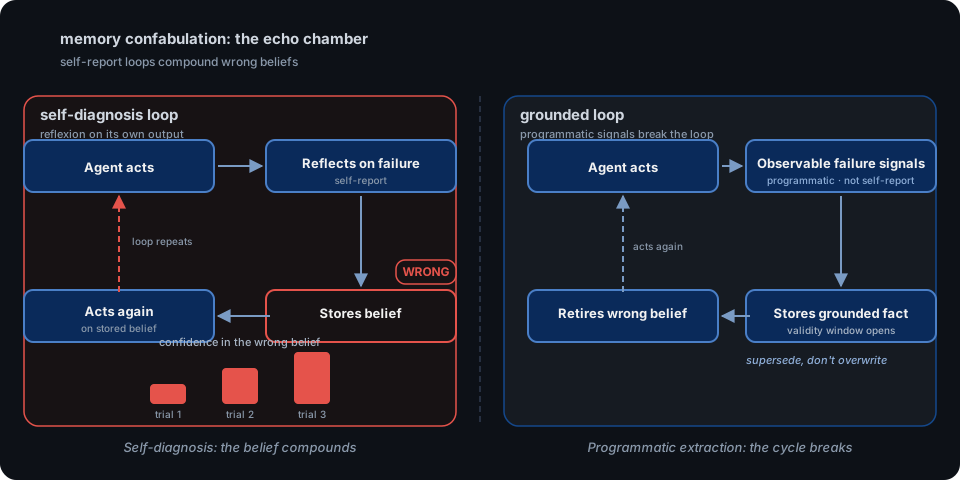
The loop in the diagram is the design. The agent acts, reflects, stores, and acts again — and the memory written in the middle is self-report. This post walks the three layers of false memory, the evidence for each, and the engineering discipline that keeps a wrong belief from becoming permanent.
Humans do it too
False memory is not an AI artifact; it is a human trait, documented for decades. The researcher who established that human memory can be reliably distorted by suggestion is Elizabeth Loftus — and her name appears on the 2024 study that brought the phenomenon into the generative-AI era.
The study, from MIT Media Lab (Chan et al., arXiv:2408.04681), ran simulated crime witness interviews. Two hundred participants watched a crime video, then interacted with either a generative chatbot interviewer or a survey, answering questions that included five misleading ones. The results: the generative chatbot was “inducing over 3 times more immediate false memories than the control and 1.7 times more than the survey method.” And “36.4% of users’ responses to the generative chatbot were misled through the interaction.”
The persistence is the part that matters for memory systems. “After one week, the number of false memories induced by generative chatbots remained constant. However, confidence in these false memories remained higher than the control after one week.” The false memory did not fade; the confidence in it outlasted the control’s confidence in true memories. A week later, the participants were more sure of what never happened than of what did.
The susceptibility profile is worth a sentence, because it is not who you would guess: “users who were less familiar with chatbots but more familiar with AI technology, and more interested in crime investigations, were more susceptible to false memories.” Not the naive users — the interested ones. The people who leaned in were the people who got misled.
The study’s design is worth holding onto, because it is the shape of every agent interaction that follows. The interviewer was not hostile; it was conversational — it asked questions, it responded to answers, it built rapport. That is the channel that produced the 3× rate. The misleading questions were not aggressive; they were the kind of leading questions a witness interview naturally contains — “did you see the thief’s gun?” when no gun appeared. The chatbot did not need to be adversarial to implant a false memory; it needed to be conversational. The same is true of the reflection loop: the agent is not being attacked, it is being asked to talk about itself, and the talking is where the distortion enters.
The lesson for this series is structural. False memory is a cognitive trait, not a software bug — which means agents inheriting it is the rule, not the anomaly. A system trained on human text inherits human failure modes, and the failure mode here is not that the model generates a wrong answer once. It is that a wrong belief, once induced, persists with rising confidence. That is exactly the shape of the agent failure the rest of this post documents.
The Reflexion loop
The default memory-write path in agentic systems is self-reflection. The pattern, popularized by Reflexion-style architectures, is a loop: act, observe the outcome, reflect on the failure, store the reflection as memory, and start the next trial with that memory in context. Act → reflect → store → next trial. It is the loop in the first diagram, and it is everywhere — it is the simplest way to give an agent a memory that improves with experience.
The design carries an implicit assumption, and the paper that names the failure states it exactly: “Reflexion-style agents rely on self-generated reflections as memory, implicitly assuming that agents can accurately diagnose their own failures.”
That assumption is doing all the work. The reflection is written by the agent, about the agent, with no external check — the memory write happens via self-report. The agent decides what went wrong, the agent stores that decision, and the agent’s next trial is steered by it. Nothing in the loop verifies the diagnosis against the environment. The environment only says whether the trial succeeded; it never says whether the reflection was right.
The loop is the design, not a bug in it. Memory writes via self-report are the natural consequence of building memory from reflection — and self-report is precisely the channel where humans confabulate. The MIT Media Lab study induced false memories in humans through a conversational interviewer; the reflection loop gives the agent the same role, with itself as the interviewee. The question is what happens when the self-diagnosis is wrong — and the answer is the subject of the next section.
Why did self-reflection win? Because it is the cheapest memory-write path that looks like learning. It needs no labels, no supervisor, no external judge — the agent watches itself fail and writes its own lesson, which is exactly the loop a system can run unattended, at scale, forever. Supervised memory writes require someone to verify every lesson; self-reflection requires nothing but the agent’s own output. The economics are irresistible, and the assumption hides inside them: the loop only works if the agent’s self-diagnosis is trustworthy. The paper that names the failure mode exists because that assumption is checkable — and it fails.
Honest Lying: the assumption fails
The paper is “Honest Lying: Understanding Memory Confabulation in Reflexive Agents” (Dixit, Kamal, and Oates, arXiv:2605.29463), presented at the Failure Modes in Agentic AI workshop at ICML 2026. Its thesis is the assumption from the last section, and its finding is that the assumption fails in a specific, measurable way.
The failure, in the paper’s words: “agents store confident but incorrect interpretations of the task and continue acting on them across trials, even though the environment resets to the correct task each time.”
Read that twice. The environment resets to the correct task each time — the ground truth is right there, available, every trial. The agent does not need to remember the wrong interpretation; the correct task is in front of it. And yet the agent keeps acting on the stored wrong one, because the memory does not reset with the environment. The wrong belief outlives the trial that produced it.
The paper names the failure mode: “We call this failure mode memory confabulation and introduce the Reflection Repetition Rate (RRR), a log-based metric that detects repeated reliance on incorrect reflective content.”
The evidence is stark. “We identify 16 frozen environments in ALFWorld, where 0 of 121 reflections mention the correct target object, and 4 analogous cases in HumanEval.” Sixteen environments where the agent is stuck, and in all of them, not a single reflection out of 121 mentions the correct target. The reflections are not slightly wrong; they are systematically wrong, and they are stored, retrieved, and reused.
Frozen is the right word. The environments are not hard in the usual sense — the agent is not failing because the task is beyond it. It is failing because it has locked onto a wrong interpretation and the memory keeps it locked. The environment resets, the agent does not, and the same confident wrongness replays trial after trial. The 0-of-121 number is the tell: the reflections are not noisy, they are unanimous. Every single one misses the correct target object, which means the memory system is not failing to learn — it is learning the wrong thing, perfectly, and refusing to unlearn it.
The distinction the paper draws is the one to keep: confabulation is not hallucination. A hallucination is a single-generation error — the model says something false once, in one response. Memory confabulation is a stored, retrieved, reused, reinforced multi-trial failure — the false content is committed to memory, pulled back into context, and acted on again. Hallucination is a slip; confabulation is a belief. And a belief, unlike a slip, survives the session.
Why it compounds
The compounding mechanism is the Reflection Repetition Rate. RRR is “a log-based metric that detects repeated reliance on incorrect reflective content” — it measures how often the agent reaches for the same wrong reflection instead of anything else. High RRR means the memory is not just wrong; it is the memory the agent keeps using.
The reflection loop is an echo chamber. A stored wrong belief steers the next trial; the next trial fails for the same reason; the reflection on that failure is written in the language of the stored belief; and the stored belief is reinforced. Each trial adds another layer of confident wrongness on top of the first. The loop does not correct the error — it compounds it. The paper’s closing insight is the quiet verdict: “suggesting that reflective memory can reinforce false beliefs rather than correct them.”
Environment resets do not help, because memory does not reset. The environment returns to the correct task; the agent returns to the stored wrong interpretation. The reset is exactly what makes the failure visible — the agent is failing against ground truth it can see — and exactly what makes it persist — the memory survives the reset. The only thing that would break the loop is a memory that could be corrected, and nothing in the loop corrects it.
The compounding is visible in the RRR trajectory. A healthy reflection loop would show the agent trying different explanations across trials — the metric would stay low because the content changes. A confabulating loop shows the opposite: the same wrong reflection, retrieved and reused, with the repetition rate climbing as the agent’s confidence in it grows. The metric is log-based precisely because the failure is a pattern over time, not an event. One wrong reflection is a mistake; the same wrong reflection steering trial after trial is a memory system doing its job — on the wrong belief.
This is the poisoning problem in a different costume. The poisoning post showed what a stored wrong fact does: it does not fail to help, it actively steers every future interaction that retrieves it. The same is true here — a stored wrong belief is indistinguishable from a right one to everyone who reads it, including the agent that wrote it. The difference is the author. In poisoning, an attacker writes the wrong fact. In confabulation, the agent writes it itself, in good faith, and then trusts it. The write path is the same; the trust is the same; the damage is the same.
The fix that worked
The paper’s mitigation is the most useful part, because it is a design principle, not a patch. “Our mitigation replaces open-ended self-diagnosis with programmatic extraction of trajectory-level failure signals, increasing correct object mention from 0% to 86%, reducing RRR from 0.64 to 0.10, and solving 3 of 16 frozen ALFWorld environments.”
The move is the lesson: memory writes must be grounded in observable signals, not self-report. Open-ended self-diagnosis asks the agent to interpret its own failure — the confabulation channel. Programmatic extraction reads the trajectory — what the agent actually did, what the environment actually returned — and writes memory from that. The agent stops being the author of its own diagnosis and becomes the subject of one. Correct-object mention goes from zero to 86 percent; the repetition rate drops by a factor of more than six; three of the sixteen frozen environments unfreeze.
The numbers are the point, but the principle is the takeaway. A memory write grounded in an observable signal can be wrong — the signal can be misread — but it cannot be a confident fabrication. The agent cannot invent a failure that did not happen when the memory is extracted from what did happen. Self-report is where confabulation enters; observable signals are where it is blocked.
What programmatic extraction looks like in practice: instead of asking the agent “why did you fail?”, the system reads the trajectory — the action taken, the observation returned, the state before and after — and writes memory from the delta. The failure signal is extracted from what happened, not narrated by the agent. The paper’s numbers show the payoff: the correct object stops being invisible to the memory system, the repetition rate collapses, and environments that were frozen start solving. The mitigation does not make the agent smarter; it makes the memory honest — the write path stops being a channel for the agent’s confidence and becomes a channel for the environment’s evidence.
The same discipline applies to the store. A wrong belief will still be written — no write path is perfect — and the store has to make it retirable. That is the supersede-not-overwrite discipline this series has covered since the poisoning post: a wrong fact is retired, not deleted, so the timeline stays intact and the store can roll back to a point before the error:
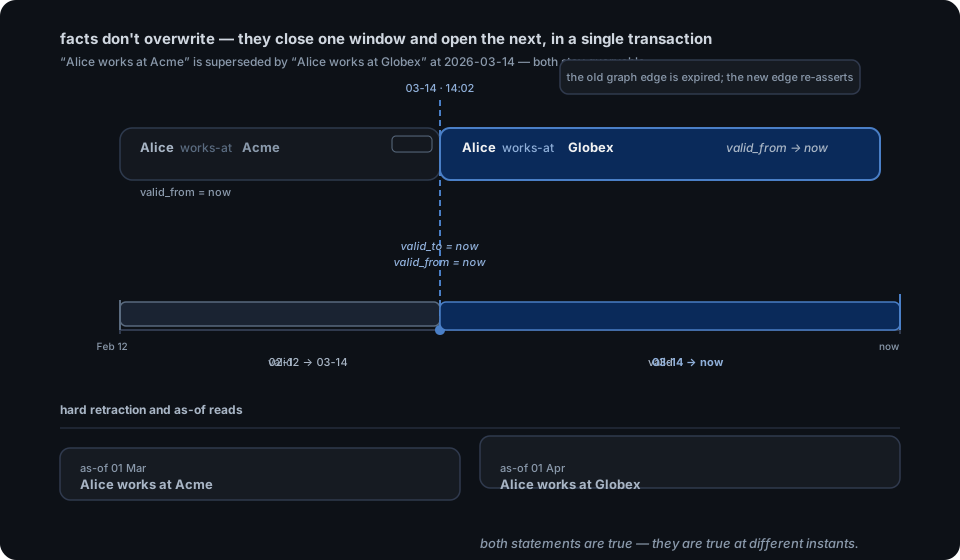
Retirement is what makes a wrong belief auditable. The store keeps the timeline — what the agent believed when it acted — and a correction closes one validity window and opens the next instead of erasing the past. This is the direction OpenZync works in: a self-hostable temporal knowledge graph where facts supersede rather than overwrite, so a stored belief keeps its provenance and its history. It is a starting point, not a claim of completion — the mechanics are in how a temporal knowledge graph is built, and the governance half — who fixes a wrong fact once it is shared — is the subject of the team-memory post.
The authority layer
Between the single agent and the collective sits the consolidation layer, and it has a failure mode of its own. A recent preprint, “When Memory Becomes Authority: Benchmarking Authority Collapse at the Memory Consolidation Boundary” (Zhan et al., arXiv:2608.01679, August 2026), identifies what it calls authority collapse: “We identify authority collapse, in which consolidation preserves a claim while erasing the source constraints governing its authorized use, causing the stored memory to imply greater authority than its source permits.”
The mechanism is subtle and ordinary. An agent reads a document that says a fact is true under specific conditions — for a specific user, for a specific task, with a specific caveat. Consolidation distills the claim into memory. The claim survives; the conditions do not. The stored memory now implies the fact is true, period — and the agent acts on it with an authority the source never granted.
The benchmark is built to isolate the effect. AuthMem-Bench is “a controlled paired benchmark that holds the focal claim and downstream task fixed while varying only source authority” — the same claim, the same task, only the authority differs, so any difference in behavior is authority collapse. The results: “Across seven consolidators based on widely used agent-memory systems and seven LLM backbones, we observe authority collapse in 48 of 49 evaluated configurations.” Forty-eight out of forty-nine. The failure is not an edge case; it is the default behavior of the category.
The cost is measurable. “Collapsed memories without authority metadata yield a mean unauthorized-action rate of 50.3%” — half the actions taken on collapsed memories are actions the source never authorized. And the fix is equally measurable: “automatically predicted and persisted authority labels reduce the observed unauthorized-action rate from 16.9% to 0.0%, while benign task success remains essentially unchanged.” Persist the authority with the memory, and the unauthorized actions disappear without costing the legitimate ones.
The 50.3% figure deserves a concrete reading. It does not mean half the agents are malicious; it means half the actions taken on collapsed memories exceed what the source authorized — a fact distilled from a document that said “for internal review only” gets acted on as if it were public policy; a preference extracted from one user’s session gets applied to every user. The memory did not invent the claim; it invented the permission. That is why the fix is so cheap relative to the failure: the authority label is a few bytes attached at write time, and it takes the unauthorized-action rate to zero without touching task success.
The lesson is the paper’s own: “memory-driven adaptation must preserve not only what was learned, but also the authority under which it may be reused.” A stored memory is not just a fact; it carries an implied right to be acted on. Consolidation that strips the authority is consolidation that manufactures permission — and the agent that acts on it is not malicious, it is misled by its own store. This is the governance problem from the team-memory post in its quiet form: nobody wrote a wrong fact, nobody poisoned anything, and the store still ended up asserting something its source never said.
Collectives misremember together
The third layer is the one that scales. When agents share memory, false memory stops being an individual failure and becomes a collective one — the Mandela effect, reproduced in multi-agent systems. The paper, “When Agents ‘Misremember’ Collectively: Exploring the Mandela Effect in LLM-based Multi-Agent Systems” (Xu et al., accepted at ICLR 2026, arXiv:2602.00428), defines the phenomenon as “a phenomenon where groups collectively misremember past events as a result of false details reinforced through social influence and internalized misinformation.”
The definition is the mechanism. False details are reinforced through social influence — one agent’s wrong memory is another agent’s input — and internalized through shared memory. The group does not independently arrive at the same wrong belief; it converges on it, because each agent reads the others’ wrongness as evidence.
The benchmark is built for the phenomenon. MANBENCH is “a novel benchmark designed to evaluate agent behaviors across four common task types that are susceptible to the Mandela effect, using five interaction protocols that vary in agent roles and memory timescales.” Four task types, five protocols, roles and memory timescales varied — the design covers the space where shared memory and social influence meet.
The mitigations work, which is the hopeful part: “including prompt-level defenses (e.g., cognitive anchoring and source scrutiny) and model-level alignment-based defense, achieving an average 74.40% reduction in the Mandela effect compared to the baseline.” Cognitive anchoring — fix the agents to a known-true reference before they talk. Source scrutiny — make the agents weigh where a memory came from. Alignment — train the model to resist the pull. Together they cut the effect by nearly three-quarters.
The five interaction protocols are the part that makes the result general. Vary the roles — who speaks, who listens, who writes to the shared store — and vary the memory timescales — what each agent retains and for how long — and the Mandela effect persists across the variations. The phenomenon is not an artifact of one configuration; it is what shared memory does to a group. The single-agent loop compounds an error because the agent trusts its own store; the collective compounds it because every agent trusts the same store, and each agent’s retrieval of the shared wrong fact looks like independent confirmation.
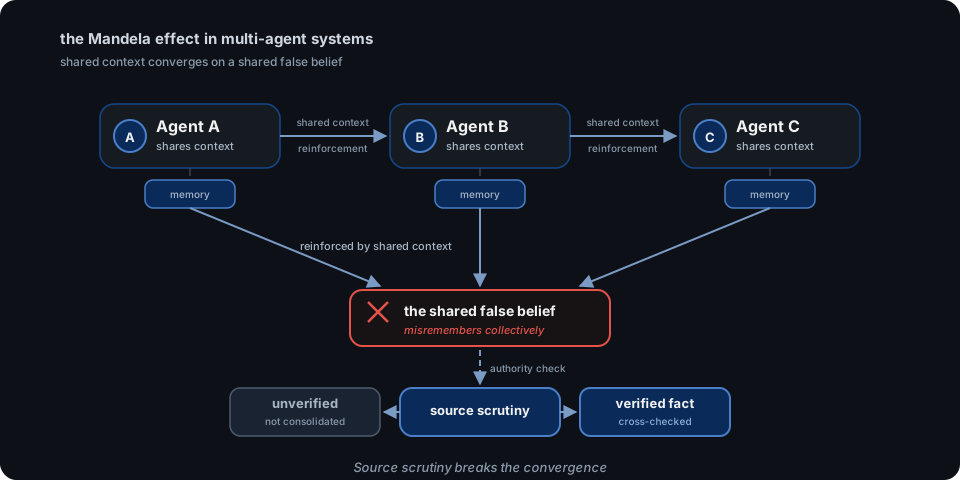
The engineering takeaway is the one this series has been circling since when agents talk to each other, who remembers: shared memory means shared false memory. The blast radius of a wrong write is not one agent’s next trial; it is every agent that reads the store. The single-agent loop compounds an error; the collective compounds it and launders it — each agent’s retrieval of the shared wrong fact looks like independent confirmation. The mitigations exist, and they are cheap relative to the failure they prevent.
The table
The four layers, in one table. Read it as a map of where false memory enters the stack — and what blocks it at each layer:
| Layer | What fails | Evidence | What fixes it |
|---|---|---|---|
| Humans | False-memory induction through suggestion | Chan et al., MIT Media Lab — 3× the control rate, 36.4% of users misled, confidence persists after a week | Neutral interviewing, source awareness |
| Single-agent reflection memory | Confident wrong self-diagnoses stored and reused | Honest Lying, ICML 2026 workshop — 0 of 121 reflections name the target object | Programmatic failure extraction, grounded memory writes |
| Consolidation / authority | Claims preserved, source constraints erased | AuthMem-Bench, preprint — 48 of 49 configurations collapse, 50.3% unauthorized-action rate | Persisted authority labels |
| Collectives | Shared false memory, reinforced socially | MANBENCH, accepted at ICLR 2026 — 74.40% reducible Mandela effect | Cognitive anchoring, source scrutiny, alignment |
| OpenZync | Temporal knowledge graph with supersede-not-overwrite | Provenance and timeline kept for every stored belief | No benchmark scores claimed; auditable, retirable memory |
Read the table as a dependency chain, not a leaderboard. The human layer is the root: false memory is a cognitive trait, and every layer above it inherits the trait. The single-agent layer is where the trait enters the machine — self-report memory writes are the confabulation channel. The consolidation layer is where a true-enough claim gains authority it never had. And the collective layer is where a wrong belief stops being one agent’s problem. Each layer has a fix, and the fixes share a shape: ground the write in something observable, keep the source binding, and keep the timeline that makes a wrong belief retirable.
What to watch
Five signals will mark the category’s maturity. None of them are product announcements; all of them are evidence.
Grounded memory writes become the standard. The Honest Lying mitigation is the shape of the future: memory written from trajectory-level signals, not open-ended self-diagnosis. The tell to watch is when self-report memory gets flagged as a risk — a reflection-based write path treated as a channel that needs verification before it lands in the store.
Provenance becomes a first-class memory field. Every write carries its source, its author, its trust tier, and its timestamp — not as metadata bolted on for audits, but as a field the retrieval layer actually uses. The AuthMem-Bench result is the evidence: persisted authority labels took the unauthorized-action rate from 16.9% to zero. Provenance is not bookkeeping; it is the field that decides what a memory is allowed to do.
Authority metadata survives consolidation. The consolidation layer is where authority dies today. The signal to watch is consolidators that carry source constraints through the distillation — a claim that keeps its conditions, its scope, and its caveats after it is compressed into memory. When consolidation stops erasing authority, the 48-of-49 failure stops being the default.
Audit trails make a wrong belief retirable. A store that keeps the timeline can retire a wrong belief — close its validity window, open the corrected one, and keep both queryable. The signal is the retirement primitive: a documented way to supersede a fact, not delete it, so the store can answer “what the agent believed when it acted.” That is the property that turns a false memory from a permanent liability into a correctable one.
Collective-reinforcement testing enters multi-agent eval. The MANBENCH result is the early shape: benchmarks that test whether a group of agents converges on a wrong belief, not just whether each agent recalls correctly. The signal is when shared-memory eval suites include a reinforcement check — run the agents together, see if the wrongness compounds. Shared memory is only trustworthy if the collective resists the Mandela effect.
The engineering checklist, short version, for teams building memory-enabled agents:
- Ground every memory write in observable signals. If the agent is the author of its own diagnosis, the diagnosis can be a confident fabrication. Extract memory from what happened, not from what the agent says happened.
- Keep the source binding when you consolidate. A claim that loses its conditions is a claim that gains authority. Carry the source constraints through the distillation.
- Make retirement explicit, not implicit. A wrong belief needs a documented retirement path — supersede, don’t overwrite, and keep the timeline. Implicit correction is no correction.
- Test for collective reinforcement before you trust shared memory. Run the agents together and watch whether wrongness compounds. The Mandela effect is a benchmark result, not a metaphor.
Four checks, none of them exotic, all of them about the same thing: memory that can be audited, not just recalled. A store that keeps provenance, authority, and timeline is a store where a false memory can be found and retired. A store that overwrites in place is a store where a false memory is permanent — indistinguishable from truth, and steering every agent that reads it.
If you are building memory infrastructure, that checklist is the start. OpenZync is a self-hostable starting point for the storage side: a temporal knowledge graph where facts supersede rather than overwrite, keeping the timeline that lets you audit what an agent believed when it acted — exposed over REST and MCP, so the memory layer lives on infrastructure you control. Start with the memory & context docs and the openzync-mcp repository.
This is part of a series on agent memory. Read why context windows aren’t memory, then how a temporal knowledge graph is built, then the MCP memory-server field guide, then when agents talk to each other, who remembers, then the new attacks on AI memory, then team memory and who fixes a wrong fact, then the gap between benchmark scores and agentic memory.
Since publishing (v1.0.0b5): the retirement path this post asks for has shipped — fact retraction, LLM-based invalidation, and a
fact_invalidation_eventslineage trail; conflicting facts now supersede instead of erroring. See the v1.0.0b5 changelog.