
Ask an agent built in 2023 what a customer told it last month, and it will cheerfully make something up — not because it's lying, but because it has no idea. The context window, however large, is working memory: it holds whatever fits in the current prompt and forgets everything the moment the conversation ends.
Bigger windows don't fix this. They delay the forgetting and quietly raise the price of every call. What agents actually need is a memory layer — a system that decides what to persist, structures it so it can be retrieved, and injects the relevant pieces back into the prompt when they matter.
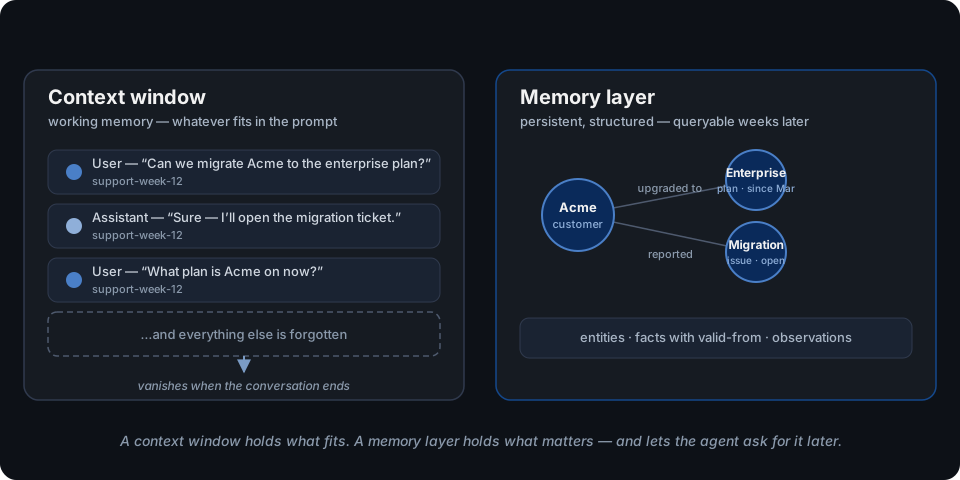
This post walks through the agent-memory landscape as it stands in mid-2026, then builds something real with it: a support agent that genuinely remembers its customers. No theory-only tour — we'll trace one scenario end to end.
Memory went from niche to discipline in under two years
By early 2026, every major platform ships some form of cross-session memory — ChatGPT's persistent timeline, Claude's project memory, Gemini's renamed "Memory". Venture money flowed into dedicated memory startups, and the field grew its own benchmark suite: LoCoMo, LongMemEval, and BEAM are now the standard way to argue about who remembers better. Mem0's public reports show 94.4 on LongMemEval at roughly 6,900 tokens per query; Zep's temporal Graphiti engine claims a 63.8% score on the temporal sub-task — about fifteen points clear of vector-only baselines.
What these benchmarks measure matters more than the numbers. They don't test "can the model answer from a big prompt?" They test the things agents actually fail at: temporal recall ("last week we tried approach A — why?"), multi-hop reasoning ("find all suppliers of suppliers of company X"), and consolidation at scale (100K+ memories without losing nuance).
A model with a large context window is still a goldfish. The benchmarks made that measurable — and it changed how production teams build.
The scenario: a support agent that remembers
Let's make this concrete. Say you run support for a B2B SaaS. You want an agent that drafts replies, surfaces the right context, and hands escalation notes to humans.
Week one, a customer named Acme Corp opens a ticket: "We need to move to the enterprise plan — compliance is pushing us." Your agent helps, ticket closes.
Week three, Acme opens another: "Why is our bill higher than expected?" A stateless agent sees a brand-new conversation. It doesn't know Acme just upgraded, doesn't know the migration ticket is still open, and certainly doesn't know compliance was the trigger — which means it can't explain the bill, and it can't flag the churn risk simmering underneath.
Every agent team hits this wall. The fix is memory — but which kind, and maintained how? That's where the 2026 landscape splits.
The three camps, and where each one breaks
Vector memory — easy, but blind to structure
The default: embed every message, store in a vector DB, retrieve by similarity. It's the fastest thing to ship, and it nails "semantic recall" — paraphrase-insensitive search over anything you've ever stored.
But in our scenario it trips on two things. First, exact matches: "Acme", "ENTERPRISE-PLUS", "ticket #4821" — embedding similarity routinely misses exact identifiers that matter. Second, connection: vector retrieval returns similar text, not related facts. "What escalated this account?" requires following relationships, not measuring distance between strings.
Graph memory — connected, but goes stale
Knowledge graphs — entities as nodes, relationships as edges — are the backbone of multi-hop reasoning: "Acme upgraded to Enterprise in March", "Enterprise triggered the billing review", "billing review is stuck". This is the structure a support agent desperately needs.
The catch is maintenance. A graph is only as good as its last update. If nobody runs extraction, the graph quietly describes a company from last quarter. And once facts go stale, the agent confidently answers with yesterday's truth — which is worse than no answer, because it's indistinguishable from a correct one.
Episodic / temporal memory — the missing dimension
Plain graphs represent what is true, not what was true. Acme was on the free plan in February, enterprise in March. Both statements are correct; they're correct at different times. Temporal memory adds validity windows and invalidation — and it's the least talked about of the three, because it's the hardest to do well.
This is also the field's open research frontier: memory verification (a hallucination stored once contaminates every future retrieval) and outcome-weighted retrieval (surfacing memories that led to good results, not just recent ones).
The build: wiring all three together
None of the three camps wins alone, and our support agent needs all three: vector for recall, graph for connections, temporal for truth-over-time. So let's build it the way we'd actually run it — with an ingestion pipeline, a graph, and hybrid retrieval that blends all three.
We'll use OpenZync, the open-source memory layer we maintain — mostly because this post would be dishonest if it described an architecture we don't run ourselves. The pattern below applies to any stack.
Step 1 — ingest conversations, then go home
Messages arrive, get persisted, and return immediately with a job ID. Enrichment — classification, entity extraction, fact extraction, embedding — happens asynchronously in the background, so ingest never blocks the request:
from openzync import AsyncOpenZync

async with AsyncOpenZync(api_key="oz_live_...") as client:
    await client.memory.ingest(
        session_id="acme-week-12",
        idempotency_key="acme-w12-001",   # replay-safe
        messages=[
            {"role": "user", "content": "We need to move to the enterprise plan — compliance is pushing us."},
            {"role": "assistant", "content": "Starting the migration ticket. Enterprise features go live after billing review."},
        ],
    )
Two details matter here. First, idempotency — network retries and webhook replays are normal, and duplicate side effects are not. Second, the pipeline itself is crash-safe: each enrichment step sets a bit in an 8-bit status mask, so a worker that dies mid-way resumes where it left off instead of redoing the whole pass. A reconcile job re-processes stragglers every few minutes.
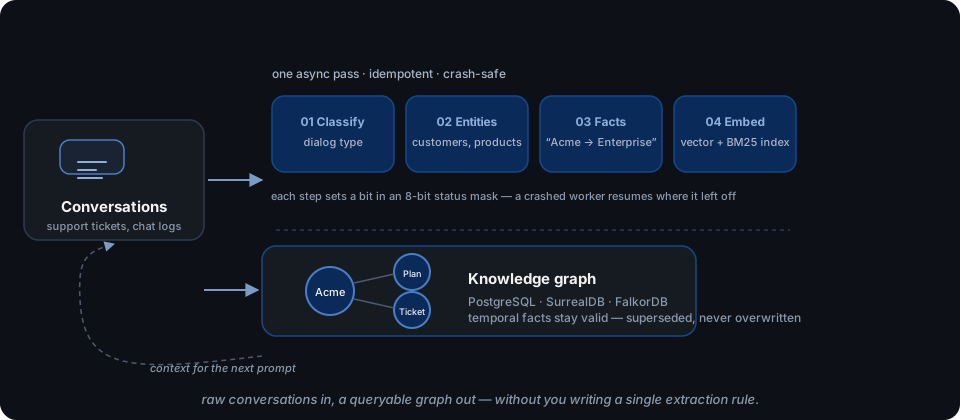
Three weeks later, Acme's week-1 and week-3 conversations have become the same connected structure: Acme → enterprise plan (valid from March), migration ticket (open), compliance (the reason). No extraction rules written by hand — the LLM pass extracts entities and fact triples, and temporal facts carry validity windows instead of overwriting each other.
Step 2 — ask the question the right way
Now the week-3 ticket arrives: "Why is our bill higher than expected?" Retrieval runs five legs in parallel — vector search over episode embeddings, BM25 exact-match over episodes and facts, a breadth-first walk of the graph, and as-of-today fact lookup — then fuses the ranked lists with Reciprocal Rank Fusion. No score normalization, no one leg drowning out the others.
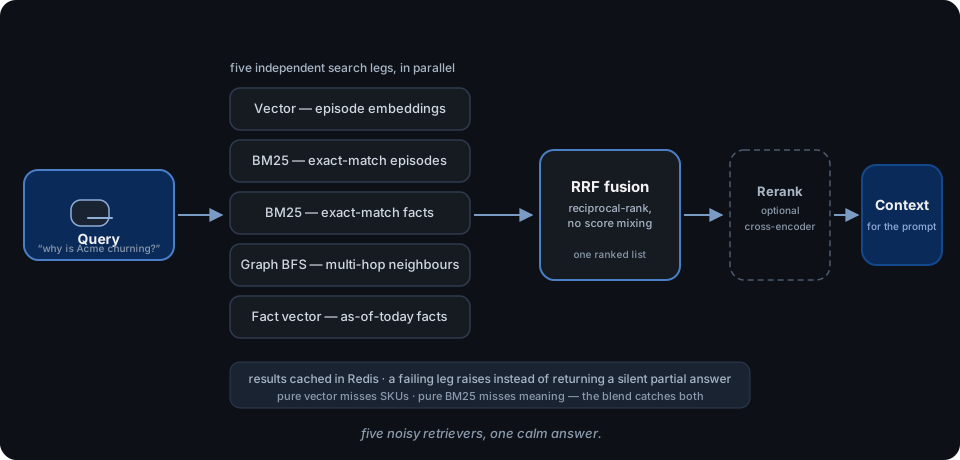
The vector leg finds the semantically similar ticket. The BM25 legs catch exact identifiers like ENTERPRISE-PLUS and ticket numbers. The graph leg walks from Acme to the billing review node. And the temporal leg knows the enterprise upgrade is the current reason for the higher bill — not the free-plan pricing from February. Each leg would fail alone; together they answer the actual question.
    context = await client.memory.get_context(
        query="Why is Acme's bill higher than expected?",
    )
    # -> a formatted context block, ready to inject into the prompt
Step 3 — what the agent can now say
With the right context injected, the draft reply writes itself:
"Your bill increased because Acme moved to the enterprise plan on March 14 (compliance-driven, per your migration ticket #4821). That migration is still in progress — the pro-rated charges land on the next cycle. Here's the migration status..."
A stateless agent would have guessed. This one knows — because the memory layer connected a ticket from week one to a question in week three, and because it respects when facts became true.
What changed: before and after
| Capability | Stateless agent | With a memory layer |
|---|---|---|
| Recall a 3-week-old conversation | Invented | Retrieved verbatim |
| Explain a price change | Guessed | Cited the upgrade + date |
| Connect two tickets from one account | No | Graph path: Acme → ticket → plan |
| Know a fact was true then, not now | Overwrites truth | Temporal validity + supersession |
| Survive a crash mid-enrichment | Re-extracts everything | Bitmask-resumes, idempotent |
The takeaway
Context windows are a capacity story; memory is a structure story. The teams winning with agents in 2026 stopped trying to stuff more tokens into the prompt and started asking a better question: what should the agent be able to remember, and how do we keep that memory true over time?
The honest answer to that question is still evolving — memory verification and outcome-weighted retrieval are genuinely open problems. But the production pattern is settled: vector recall, graph connection, temporal truth, and hybrid retrieval fusing all three. The support agent above is that pattern in miniature: raw conversations in, a queryable graph out, and a draft reply that finally remembers what a customer said three weeks ago.
If you want to see the same pipeline in your own stack, the quickstart takes about ten minutes — or browse the memory & context docs for the retrieval details. There are working examples in the openzync-examples repo, including a support-agent pattern like this one.