
Most "long-term memory for agents" projects are the same architecture: dump everything into a vector store, chunk, embed, top-k retrieve, stuff into the prompt. That works until it doesn't — the agent remembers the corrected fact and the original, can't answer "when did this change?", and the "graph" is decorative.
OpenZync makes a different bet: agent memory as a temporal knowledge graph, where facts are versioned rows and correctness is a database property, not a prompt-engineering hope. The core is AGPL-3, self-hostable, bring-your-own-LLM.
The architecture
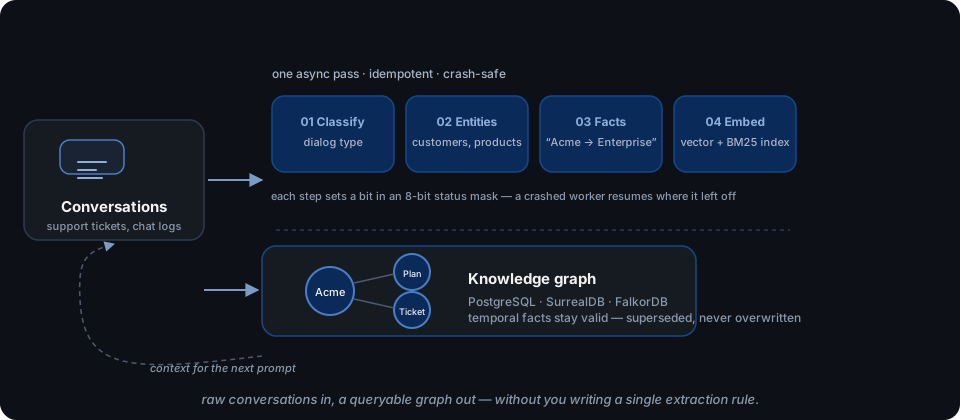
FastAPI monolith + ARQ workers + PostgreSQL 15 (pgvector) + Redis 7. The pipeline is four stages:
- Ingest —
POST /v1/projects/{id}/memorypersists conversation episodes immediately, with body-hash idempotency on the write path. - Enrich — ARQ workers asynchronously extract entities, SPO facts, dialog classifications, and embeddings. The LLM provider is pluggable: OpenAI, Anthropic, Ollama, Azure, OpenRouter — bring your own keys.
- Graph sync — entities and relationships materialize into the graph layer.
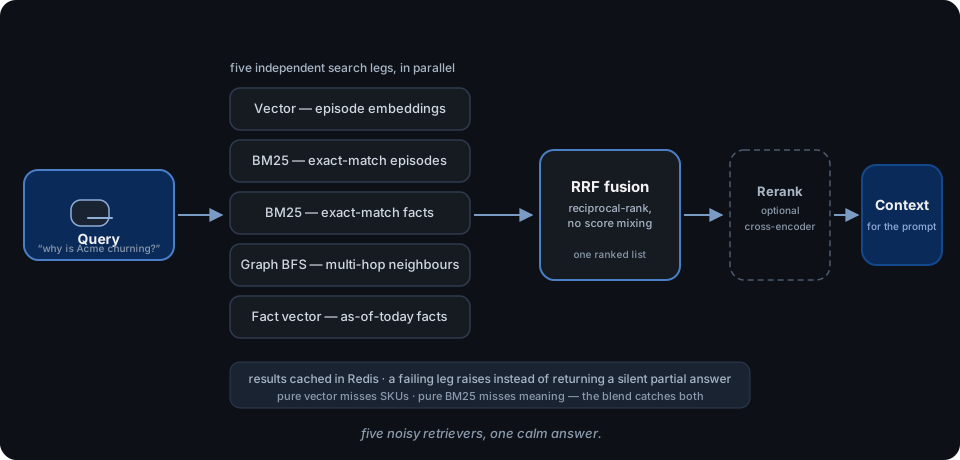
- Retrieve — hybrid search: pgvector cosine + BM25 full-text + graph BFS, fused via Reciprocal Rank Fusion into structured prompt context.
from openzync import AsyncOpenZync

async with AsyncOpenZync(api_key="oz_live_...") as client:
    await client.memory.ingest(
        session_id="acme-week-12",
        idempotency_key="acme-w12-001",   # replay-safe
        messages=[
            {"role": "user", "content": "We need to move to the enterprise plan — compliance is pushing us."},
            {"role": "assistant", "content": "Starting the migration ticket. Enterprise features go live after billing review."},
        ],
    )
The part worth arguing about: temporal correctness
Facts are stored as (subject, predicate, object) triples with a validity window (valid_from..valid_to) and a hard-retraction marker (invalid_at). When an incoming fact conflicts with an active one, it supersedes it transactionally: the old fact's window closes at now, the new one opens at now, in a single transaction. Nothing is silently dropped, nothing 409s, nothing coexists.
This replaced a previously three-way-inconsistent behavior — extraction silently dropping conflicts, the API rejecting whole batches with 409, and cross-episode facts silently coexisting (a GiST exclusion constraint scoped per episode). Three independent write paths now converge on one state machine.
Because a conflicting re-insert with identical content is skipped rather than superseded, ARQ retries are idempotent by construction: re-running a failed extraction job finds its own previously-inserted facts and skips instead of superseding them. Every read applies an effective-at predicate (valid_from <= t < valid_to, invalid_at > t), so as-of queries reconstruct the fact timeline:
"Alice works at Globex" supersedes "Alice works at Acme" — and you can walk the history.
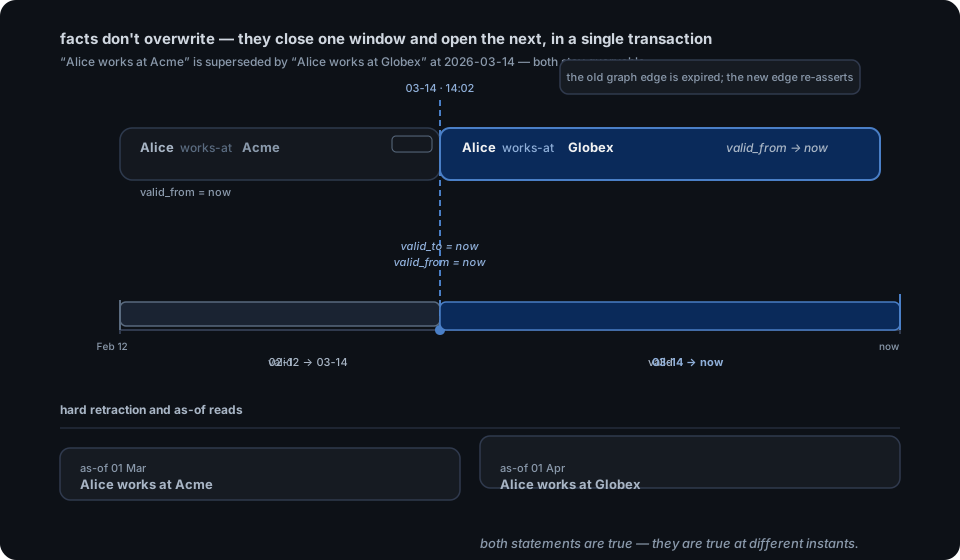
Supersession is observable, not silent: the response carries superseded_count, a FACT_SUPERSEDED webhook fires with {old_fact_id, new_fact_id, triple}, the context-cache prefix is purged, and a Prometheus counter (openzync_facts_superseded_total) tracks it.
One subtlety worth reading ADR-005 for: conflict matching is form-flexible. An extraction-derived fact (resolved entity UUIDs) and a business-data fact (plain strings) are matched via normalized SPO names, so string writers can supersede entity writers of the same triple — advisory locks key on the name form so cross-form writers serialize, while entity-match takes precedence when both sides carry both UUIDs. The final identity comparison runs in Python after aggressive normalization, backed by a partial btree index (WHERE invalid_at IS NULL).
Graph consistency is the second hard part
The graph is a pluggable layer — Postgres-native, FalkorDB, or SurrealDB. A superseded fact's edge must not keep traversing as if it were true. So:
- Postgres expires edges in-transaction with the fact write — atomic with the truncate + insert.
- FalkorDB / SurrealDB get a post-commit ARQ job with ×3 retry, on the low-priority queue.
- A
reconcile_graph_edgescron (every 5 minutes, batch-limited to 200) anti-joins active edges against active facts and self-heals any drift — which also means no migration-time backfill was required. It's the safety net and the backfill at once. - The read side takes an
as_ofinstant, so traversal is temporally correct on every backend.
The expiry derivation follows one rule per old-fact → successor transition: no successor (retraction) → expire the edge; successor with a different edge key (entity flip-flop) → expire; successor with the same edge key → keep, the successor re-asserts it. at_time is the deterministic supersession instant, never a fresh clock read, so edge and fact invalidation agree.
Search and communities
Retrieval runs multiple legs — vector similarity, BM25 exact-match (trigram + GIN indexes are in the migration history), a breadth-first graph walk, and as-of-today fact lookup — then fuses the ranked lists with Reciprocal Rank Fusion. No score normalization, no one leg drowning out the others.
 On top of the graph, Label Propagation groups related entities into communities (event-driven or nightly), so related entities cluster into navigable neighborhoods.
Platform
- Multi-tenant — org-scoped data isolation, JWT + API keys, email verification, MFA, least-privilege Postgres roles (separate DDL migrator and CRUD app roles).
- Webhooks — Svix-compatible HMAC-signed delivery with delivery logs.
- MCP server — expose memory read/write as tools to any MCP-compatible client (Claude Desktop, Cursor).
- Python SDK — Apache 2.0,
pip install openzync, with LangChain integrations. - Admin dashboard — Next.js, for graph exploration and tenant management.
The security bet: no .env fallback, ever
All runtime config lives in OpenBao. On first boot the stack auto-generates database credentials, AppRole identities, and system secrets. Exactly four bootstrap secrets start in .env, and the Postgres superuser password auto-rotates after bootstrap. The API and worker run OpenBao Agent sidecars that render secrets to a tmpfs mount at startup. If "zero-fallback secrets" is a smell to you, say so — it's deliberate.
Evaluation
Not just unit tests. There's a LongMemEval harness wired into tests/benchmarks, golden-set evals for structured extraction, entity merge, entity ontology, classification, and PII, plus an end-to-end ingestion pipeline test. Roughly 77k lines of test and evaluation code; CI runs unit + integration + security suites.
Deployment
One docker compose up bootstraps OpenBao → Postgres (least-privilege roles) → Alembic migrations (42+) → API + worker in about 60 seconds. Helm chart for Kubernetes. Requirements: PostgreSQL 15+ with pgvector, Redis 7+, and an LLM provider (local via Ollama, or cloud BYOK).
Honest status — alpha
Three gaps I'm actively thinking about:
- Semantic contradiction detection — supersession is deterministic-SPO only today ("Alice works at Acme" vs "Alice works at Globex" needs an LLM judgment step; it stays behind a feature flag).
- Business-data ingest doesn't create graph edges yet — it does supersede them, but the API ingest path doesn't materialize edges (tracked separately).
- No published performance numbers —
benchmarks/results/is empty, and I won't fake it.
Since writing: v1.0.0b5 ships temporal edge expiry with effective-at-now reconciliation, plus fact retraction and LLM-based invalidation — the supersession machinery above now has a shipped invalidation layer. See the v1.0.0b5 changelog.
License
Core is AGPLv3 (commercial license available for SaaS deployments that don't want to release modifications). The Python SDK is Apache 2.0.
If you've hit the wall where an agent confidently repeats a fact you already corrected, or you think temporal facts are overkill for associative memory — that's the conversation I want. The quickstart takes about ten minutes; the memory & context docs cover retrieval in detail; the code is at openzync-core.